
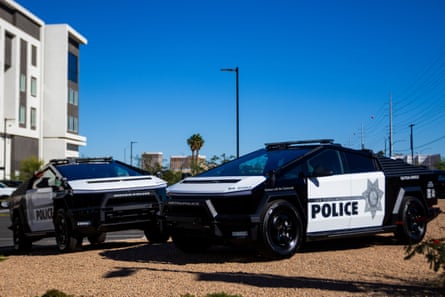
The Las Vegas police department rolled out a new fleet of tactical vehicles to city streets last month: all Tesla Cybertrucks. The steel cars, wrapped in black-and-white vinyl, come decked out with warning lights and flashing sirens on the roof. They seem to be heftier, more angular versions of a traditional police car. Las Vegas is the first city in the US to grant its officers access to a battalion of the futuristic trucks, which have become synonymous with the Tesla CEO, Elon Musk, the richest person in the world.
“They represent something far bigger than just a police car,” Sheriff Kevin McMahill said at a recent press conference showcasing the vehicles. “They represent innovation.”
News of the 10 electric Cybertrucks first rippled across Las Vegas in February when McMahill posted renderings of the cars on X, saying “These are badass” and announcing his force would soon be driving them. Another police department post on Instagram said the fleet “was entirely donated by an anonymous supporter”.
Rumors swirled about who the donor could be. It came at a time when Tesla’s sales had tanked and Musk was laying waste to the federal government’s payroll as the head of the so-called “department of government efficiency” (Doge). According to police department emails acquired by the Guardian through a public records request, the donation had been in the works since the month after Donald Trump’s election win.
“As we’ve discussed, the use of these vehicles would represent a groundbreaking approach to modern policing,” Mike Gennaro, the chief of staff for the Las Vegas metropolitan police department, wrote in an email to the donor on 1 December 2024.
The mysterious donor turned out to be Ben Horowitz, co-founder of the Silicon Valley venture capital firm Andreessen Horowitz, and his wife Felicia Horowitz. They came forward just days after McMahill posted the renderings on social media. Horowitz’s firm, one of the best-known in Silicon Valley, invests in a variety of tech companies and spent $400m to help Musk take over Twitter in 2022.
In reaction to the news, Musk replied to a post about it on X with an emoji wearing sunglasses.
Athar Haseebullah, executive director of the American Civil Liberties Union of Nevada, said that police use of these Cybertrucks seemed like an endorsement of Musk.
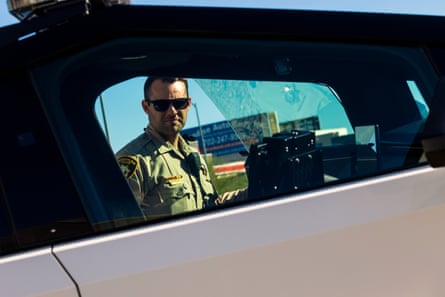
“I recognize that LVMPD sees value in having cool-looking vehicles around, and it projects an air of modernity and sophistication. But the reality is that for communities, that’s not what they’re asking for,” Haseebullah said. “They’re asking to feel safer. I don’t know that a Tesla Cybertruck makes anybody feel any safer.”
Other cities around the US have also faced blowback at the prospect of adding Teslas to government-owned fleets. Baltimore had pledged to spend $5m on Tesla sedans for municipal employees in June 2024, but by March had backed off those plans. In King county, Washington, officials faced backlash from residents for buying 120 Tesla vehicles for its municipal carpooling program. And in a handful of small towns in California, where officers have been testing Tesla sedans for law enforcement work, department chiefs say the vehicles aren’t fit for modern policing.
The Las Vegas police department, however, is optimistic. McMahill said zero taxpayer dollars were spent on the Cybertrucks because they were a donation.
The mysterious donors
The Horowitzes live in Las Vegas and have been longtime supporters of the city’s police department. According to the emails acquired by the Guardian, their Cybertruck donation included 10 vehicles for patrolling and one “sting protector” for special weapons and tactics (Swat). The donation, which is estimated at about $2.7m and was finalized in late January 2025, was funnelled through a law enforcement charity called Behind the Blue.
“The morale of the cops will be through the roof when these show up at their substations,” Gennaro wrote to Horowitz, as they hammered out the donation logistics. “And we will use them as a tool to keep morale high and cops productive.”
The police department waited for the Cybertrucks for about 10 months as they underwent upgrades by a company called UpFit, based in Hawthorne, California, which specializes in retrofitting Teslas for police work. The patrol vehicles come with barrier shields, ladders, radios and other tactical gear, according to the police department. The upgrade specifics and pricing were redacted in public records.
According to internal emails, the Swat vehicle will be used in situations that include “barricaded suspects and hostage incidents”.
Las Vegas police asked UpFit to remove Tesla’s “beast” mode on all 11 vehicles. Beast mode is a setting that Tesla says makes a Cybertruck accelerate from zero to 60mph in 2.6 seconds and can reach a top speed of 130mph.
Horowitz has made several tech-centric donations to the Las Vegas police department over the past couple of years, totalling roughly $8m. Those include license plate readers from the company Flock, drones from Skydio and an artificial intelligence tool that helps with 911 calls from the company Prepared911. These three products were created by businesses within Andreessen Horowitz’s investment portfolio, according to a report by TechCrunch. The firm is not an investor in Tesla.
In response to TechCrunch’s reporting, Horowitz wrote a blogpost emphasizing the need for public safety and quoted the rapper Nas, saying: “You can hate me now, but I won’t stop now.”
Horowitz and Tesla did not respond to the Guardian’s requests for comment.
The Cybertruck’s woes
Musk has touted the Cybertruck’s stainless steel body as being “apocalypse-proof” with the ability to withstand bullets and arrows. During his unveiling of the vehicle in 2019, he had one of his staffers throw a metal ball at the car’s window to show off what he said was “a truck that’s really tough, not fake tough”. The window shattered.
Cybertrucks have been on public roads for two years now. They have dedicated fans, but have seen dwindling sales and are banned from the European market over pedestrian safety issues. In the third quarter of this year, Tesla sold just 5,385 Cybertrucks – down 63% from the same time last year. For comparison, the Ford F-150, a similar oversized electric truck, saw sales rise by nearly 40% in the third quarter.
Some of the lackluster sales come from opposition to Musk during his time at Doge. “Tesla Takedown” protests last winter were aimed at getting people to sell their cars and a fair amount of vitriol and violence was directed specifically toward Cybertrucks. Vandals around the country spray-painted swastikas on the pickup trucks, and, in Seattle, someone set four of the vehicles on fire, engulfing them in flames.
Cybertrucks have also had a staggering number of recalls over the last two years. Among the 10 recalls, issues included side panelling that’s prone to flying off while driving, too bright front lights and a gas pedal that accelerates uncontrollably. The most recent recall, issued on 30 October, was due to the truck’s light bar being susceptible to falling off and causing a road hazard to other vehicles.
“Why didn’t they pick any other type of vehicle?” Haseebullah from the ACLU of Nevada asked. “Why would a Tesla be more efficient for police to utilize than a Ford?”
The Las Vegas police department said it dealt with those recalls before deploying its Cybertrucks on patrol last month. For Sheriff McMahill, using these trucks is about having “the most technologically advanced police department on the planet”.
“These trucks are high performance and they’re built tough,” McMahill said, echoing Ford’s “Built tough” tagline. “Cops are going to look kinda cool in them too.”
