

Zheng Yongnian delivers a speech at the 2025 Guangzhou Forum in Guangzhou on Dec. 28, 2025.
“Global geopolitics is changing. The center of geoeconomics is in the Asia-Pacific region, so the center of geopolitics is also here,” noted Zheng Yongnian, chairman of the Guangzhou Institute of the Greater Bay Area, at the recent 2025 Guangzhou Forum.
Prior to the meeting, in an exclusive interview with South, Zheng remained cautiously optimistic about China’s geopolitical challenges in 2026, highlighting the risks stemming from the rise of Japanese militarism and the continued implementation of Donald Trump’s tariff policies.
A cautious optimism regarding China’s geopolitical challenges in 2026
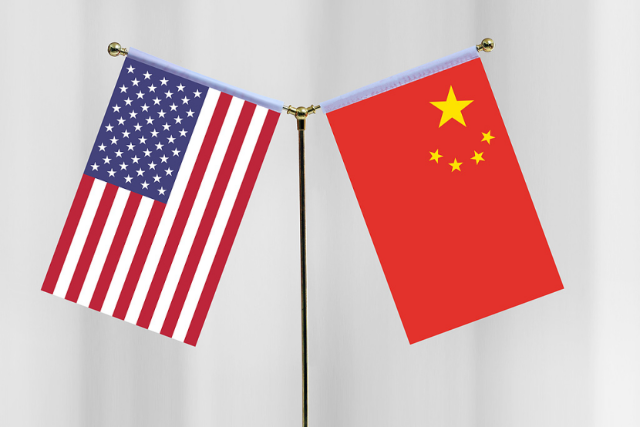
National flags of China and the US (CFP Photo)
Zheng took a cautiously optimistic stance on China’s geopolitical challenges this year. He believes that the meeting in Busan between the two heads of state last year marked a turning point in US-China relations. The year 2026 may see more opportunities.
“Donald Trump will visit China in April. The APEC meeting is set to be held in Shenzhen in November, and Trump will most likely attend. Our leader will probably attend the G20 summit, which will be held in Miami this December as well.”
“This head-of-state diplomacy is very crucial. When diplomatic consensus is reached, both sides’ bureaucratic levels can implement it. So there is a positive trend in this regard,” added Zheng.
“China and the US are the two pillars of the current international order, and neither can afford to fall,” Zheng stated. President Xi Jinping indicated that if the two major powers cooperate, many problems can be resolved. If the two countries fail to cooperate and conflict ensues, everyone will be a victim—not only the two countries themselves, but also many other nations.
Trade and economic relations act as the cornerstone of China-US relations. From Trump’s first term in 2016 to 2024, eight years of conscious decoupling have yielded no complete result. In 2024, the trade volume between China and the US exceeded $680 billion. China’s trade surplus surpassed $1 trillion last year for the first time.
“This shows that decoupling is tough and unrealistic for the two countries,” Zheng commented.
In his view, the economies of China and the US are highly complementary, far outweighing competition. The comparative advantage of the US lies in its excellent basic research, which fosters advanced technological research, software, finance, and services.
Data from the US Department of Commerce reveals that the US goods trade deficit reached $1.2 trillion in 2024, but total service exports reached $1.1 trillion, resulting in a services trade surplus of nearly $300 billion, close to a historical high. The US maintained a services trade surplus with China of about $32 billion. China is the largest source of the US services trade surplus.
Risks stem from Japanese militarism and Trump’s continued tariff policies

Japanese Prime Minister Sanae Takaichi (L) and US President Donald Trump (R) (CFP Photo)
Zheng predicts that if China-US relations continue to improve, many of America’s allies may seek to undermine this progress. Japanese Prime Minister Sanae Takaichi’s recent actions can also be interpreted in this way. With regard to Japanese militarism, if China-US relations gradually improve, Japan will have even less diplomatic room to maneuver.
He predicts that if a world war were to occur, it would be more likely to take place in the Asia-Pacific region.
He detailed the Russia-Ukraine conflict, the struggle between Israel and other countries in the Middle East, small-scale conflicts in South Asia, as well as the tensions between the US and Venezuela in Latin America. In his view, all these conflicts could not evolve into a world war.
“If a world war were to break out, it would be more likely to occur on our side. For example, regarding the Taiwan question, Japanese PM Sanae Takaichi claims that if something happens to Taiwan, something will happen to Japan. We still need to be especially careful,” he added.
Additionally, Zheng predicts that Trump’s reciprocal tariff war worldwide will probably continue to address current domestic economic imbalances. Thanks to his belief in 19th-century American expansionism, the US also imposed substantial tariffs during that period.
“Trump has no choice but to use tariffs as a tool,” Zheng noted bluntly.
The US president’s economic power is confined to financial power, not monetary power. Therefore, Trump pressured the Federal Reserve to reclaim that power. While the Fed may adjust to Trump in some areas this year, Zheng does not believe the Fed will directly fall under the president’s authority.
“What Trump is using is tariffs, which is financial power. He has no power on the monetary front. Maybe it will increase a bit in 2026, or there will be a new Federal Reserve chairman, but he won’t be completely subservient to Trump,” he said.
Zheng predicts another reason for the continued tariffs is the struggle among US allies. Take Europe and Japan as examples. After World War II, the US opened its markets to them and provided public goods.
Reporter | Zhang Ruijun
Photo | Zhang Ruijun
Editor | Yuan Zixiang, James Campion, Shen He

