
U.S. stocks ended sharply higher Wednesday after a day of whipsaw trading as President Donald Trump backed off his threat to impose tariffs on NATO allies over his bid for U.S. control of Greenland.
Major stock indexes gained back some of the ground they lost in Tuesday’s widespread sell-off, but markets remained volatile as investors processed the blizzard of global trade news over the past several days.
The dramatic ups and downs Wednesday marked a return to the early days of Trump’s “Liberation Day” tariffs in April, which sent the world into a period of prolonged uncertainty over the future of international trade.
And while markets broadly recovered throughout most of last year, Trump’s move on Greenland — and renewed threats of tariffs over the weekend — had rattled global equity and bond markets.
Wednesday’s roller-coaster ride started when Trump said he would not use force to seize Greenland, which sent many stocks higher. But those gains quickly disappeared after the European Union said it would stop moving forward with implementing a key trade deal with the U.S.
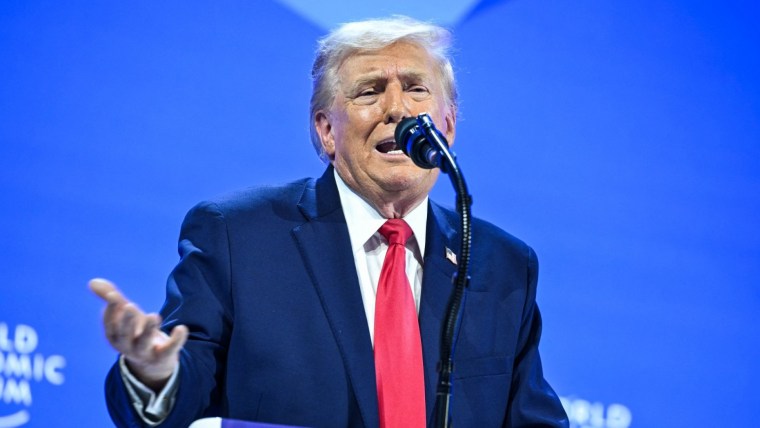
“We probably won’t get anything unless I decide to use excessive force and strength,” Trump said in a speech before world leaders at the World Economic Forum in Davos, Switzerland, “but I won’t do that.”
Shortly after 2 p.m. ET, Trump announced he would hold off on imposing those tariffs on eight European countries. That sent U.S. stocks soaring to the highs of the day.
The S&P 500 wrapped up Wednesday’s trading session higher by 1.16%. The Nasdaq Composite closed up 1.18%, and the Dow Jones Industrial Average settled higher by 588 points, or 1.21%.
Bond markets, which have become a particular focus for market watchers as a gauge of concern about U.S. action, were not as responsive. Yields on U.S. Treasurys, which rose Tuesday in a sign of investor unease, were only slightly lower Wednesday, a sign that traders remained cautious about the path forward.
Gold, a “safe haven” for investors in times of unease, continued rising Wednesday. As of 4:20 p.m. ET, it was up over 1%, bringing its gains for the year to more than 11%.
Silver and gold have soared over the last year as investors looked for ways to hedge geopolitical risk.
Since this time last year, the price of gold has risen more than 75%.
On Thursday, European leaders will hold an extraordinary meeting of the European Council, which was originally called to discuss possible retaliation measures against the U.S. in the event of new tariffs from Trump.
European countermeasures could include more than $100 billion worth of retaliatory tariffs, or triggering the bloc’s so-called trade bazooka, a legal mechanism that has never been tried before.
European markets were also on uneven ground, having closed for the night before Trump’s reversal, after two straight days of selling.
Benchmark stock indexes in Italy, the U.K. and France closed mixed Wednesday after initially having jumped and turned positive on Trump’s Davos speech.
The pan-European STOXX 600 ended the session only slightly higher after it also lost momentum. Earlier in the European trading session, and before Trump’s comments, all of the indexes were trading significantly lower.
Meanwhile, in Washington, oral arguments at the Supreme Court over the future of Federal Reserve governor Lisa Cook, whom Trump has tried to fire, also factored into investor decisions.
During the hearing, the justices appeared to be skeptical of the government’s argument that Trump should be allowed to fire Cook. In fact, some of them suggested the court could go further than simply denying an emergency application filed by the Trump administration, which would allow litigation to continue in lower courts. Instead, the court could issue a decision that sets a new legal standard for removal — one that Trump’s stated justification for firing Cook would almost certainly fail to meet.
JPMorgan Chase CEO Jamie Dimon said Wednesday morning on a panel in Davos that keeping the Western world together was important.
Dimon, the chief of America’s largest bank, said he believed a stronger Europe and NATO were critical. “I still think that’s the best thing, to keep the Western world together,” he said. “That would be my goal: make the world safer and stronger for democracy so that we don’t read that book 40 years from now, ‘How the West lost.’”
But, Dimon said, “I would be more polite” about criticizing Europe than Trump is.

