
For a long time, the operational autonomy of underwater systems has been constrained by the inability to ensure persistent operations without direct human intervention. Autonomous Underwater Vehicles (AUVs), while capable of carrying out pre-programmed missions along the water column or on the seabed, have historically required physical recovery at the end of each operational cycle for energy recharging, data transfer and mission reconfiguration.
This dependence on surface operations has represented one of the main bottlenecks in the development of long-term marine observation infrastructures, significantly limiting their effectiveness, continuity and scalability. Within this context, underwater docking technology emerges as a key enabling factor: the introduction of docking stations makes it possible to overcome the traditional operational paradigm, radically extending the autonomy of AUVs and enabling the deployment of persistent, distributed monitoring architectures with a high level of operational reliability.
Underwater docking technology
Underwater docking enables an AUV to perform approach and berthing maneuvers towards a dedicated subsea station, designed to support automatic alignment, battery recharging, bidirectional data transfer and the updating of mission parameters. Docking stations constitute key infrastructural nodes within advanced marine observation systems, allowing a reduction in dependence on surface operations and an increase in the overall duration of data acquisition campaigns.
The evolution of docking technology has followed a gradual path: from early manual or assisted solutions, which required significant operator support, to more recent implementations of automatic docking. The latter are based on precision navigation systems, acoustic and optical proximity sensors, advanced control algorithms and autonomous decision-making logics, capable of robustly managing the approach, capture and disconnection phases even under challenging environmental conditions.
Automatic docking does not represent a mere incremental improvement, but rather a paradigm shift, as it enables the transformation of the AUV from a mission-based platform into an element of a persistent system, capable of operating for extended periods without human intervention.
EdgeLab and the progressive development of docking technology
EdgeLab S.p.A., an innovative SME with its operational headquarters in La Spezia, operates in the field of advanced marine technologies, with a particular focus on the design of autonomous underwater vehicles and integrated systems for scientific, industrial and security applications. Over recent years, EdgeLab has systematically addressed the challenge of underwater docking through participation in European Union–funded research and innovation projects, developing a progressive technological pathway that has led from the implementation of manual solutions to the validation of automatic docking architectures.
Two projects, in particular, represent the main milestones of this technological evolution: NAUTILOS and M.A.R.E.
NAUTILOS: validation of manual docking in the context of sustainable marine observation
The NAUTILOS project, funded under the European Union’s Horizon 2020 research and innovation program, is focused on the development and demonstration of innovative technologies for the measurement of Essential Ocean Variables (EOVs), with the aim of addressing existing gaps in the observation of physical, chemical, biological and deep-ocean variables. The project seeks to strengthen and complement existing European observation infrastructures through the use of low-cost sensors and samplers, integrated on a range of autonomous platforms and validated through large-scale demonstrations in European seas.
Within this context, EdgeLab played an active role in the development, adaptation and validation of technological solutions for autonomous platforms, taking responsibility for sensor integration, on-board system optimization and the operational testing of underwater docking solutions as a functional element for extending AUV operational capabilities. In NAUTILOS, docking was implemented in a manual or assisted form, representing an initial testbed for the validation of mechanical, electrical and communication interfaces between the AUV and the docking station.
These activities enabled a critical analysis of operational challenges related to alignment in the presence of currents, vehicle stability, and the reliability of power connections and data flows, providing a solid technological and operational foundation for the evolution towards higher levels of autonomy.
M.A.R.E.: automatic docking as an enabling element of an autonomous ecosystem
Building on the experience gained through NAUTILOS, EdgeLab developed the M.A.R.E. project (Machine Learning Applied to Marine Ecosystem Research via AUVs), funded by the European Union – NextGenerationEU and implemented within the framework of the National Recovery and Resilience Plan (PNRR). The project is aimed at the development of an integrated system for advanced marine observation, designed to enable the coordinated measurement of Essential Ocean Variables across the entire water column through the interaction of multiple platforms.
The M.A.R.E. platform integrates an AUV, Docking Station, Lander, Hub Buoy and Ground Control Station within a modular and interoperable architecture, supported by a coherent communication network and by calibration, testing and validation procedures conducted both in laboratory environments and in controlled operational scenarios. Within this framework, automatic docking technology represents a central and distinctive element: the docking station enables the autonomous return of the AUV, energy recharging, continuous data transfer and mission reprogramming without the need for surface recovery.
 Integrated platform: AUV, docking station, ground control station, and surface buoy. Credit: EdgeLab
The docking system is supported by advanced control algorithms, system diagnostics and autonomous management logics, which allow the closure of the vehicle’s operational cycle and enable persistent and adaptive missions. While incorporating machine learning techniques for environmental data analysis, M.A.R.E. primarily represents a demonstration of the technological maturity of automatic docking, consolidating docking as an enabling technology for autonomous, scalable marine infrastructures with a high level of operational reliability.
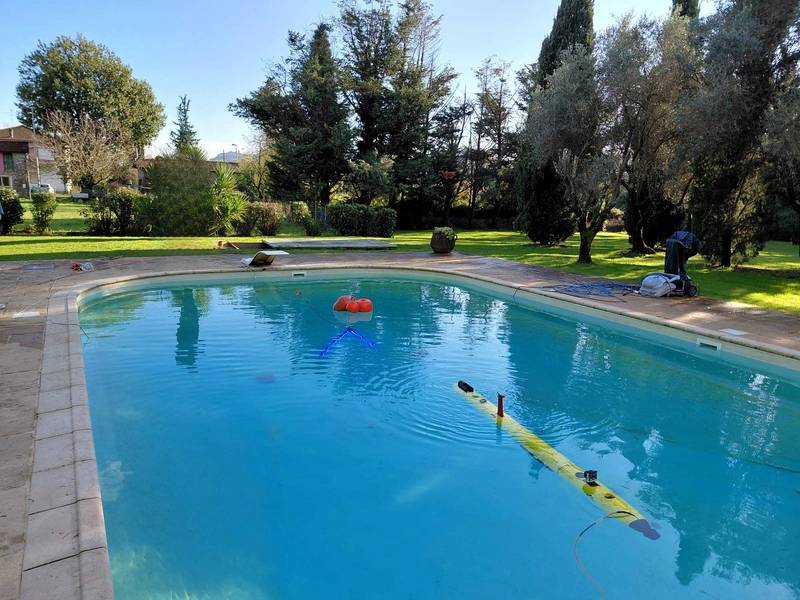 Autonomous docking pool test developed by EdgeLab, La Spezia, Italy. Credit: EdgeLab
Technological and operational implications of automatic docking
The evolution of underwater docking has implications that extend far beyond the individual vehicle. The availability of AUVs capable of autonomously returning to a subsea station enables the deployment of persistent marine infrastructures, characterized by a reduced need for logistical support and greater continuity in the data acquired.
From an operational perspective, automatic docking makes it possible to reduce the costs associated with the use of support vessels and specialised personnel, while simultaneously improving operational safety. From a systems perspective, it represents a key enabler for the scalability of observation networks, making it possible to coordinate multiple autonomous platforms within distributed architectures.
Conclusion
The development pathway undertaken by EdgeLab, from the manual docking validated within the NAUTILOS project to the automatic docking implemented in M.A.R.E., demonstrates how the operational autonomy of underwater systems is the result of a progressive evolution based on experimentation, system integration and technological maturation.
Today, automatic docking is no longer merely an ancillary feature, but a strategic enabling factor for marine observation, the sustainability of operations and the development of intelligent underwater infrastructures. Through these projects, EdgeLab has made a contribution to the advancement of a technology that is set to play a central role in the future of autonomous marine systems.
 Michele Cocco, CEO of EdgeLab. Credit: EdgeLab

