
In a nutshell
- Pax Silica shifts focus from trade to technological allies
- Coalition of nodes spans chips, energy, capital, logistics and design
- Resulting hierarchy distinguishes leaders from dependent client states
- For comprehensive insights, tune into our AI-powered podcast here
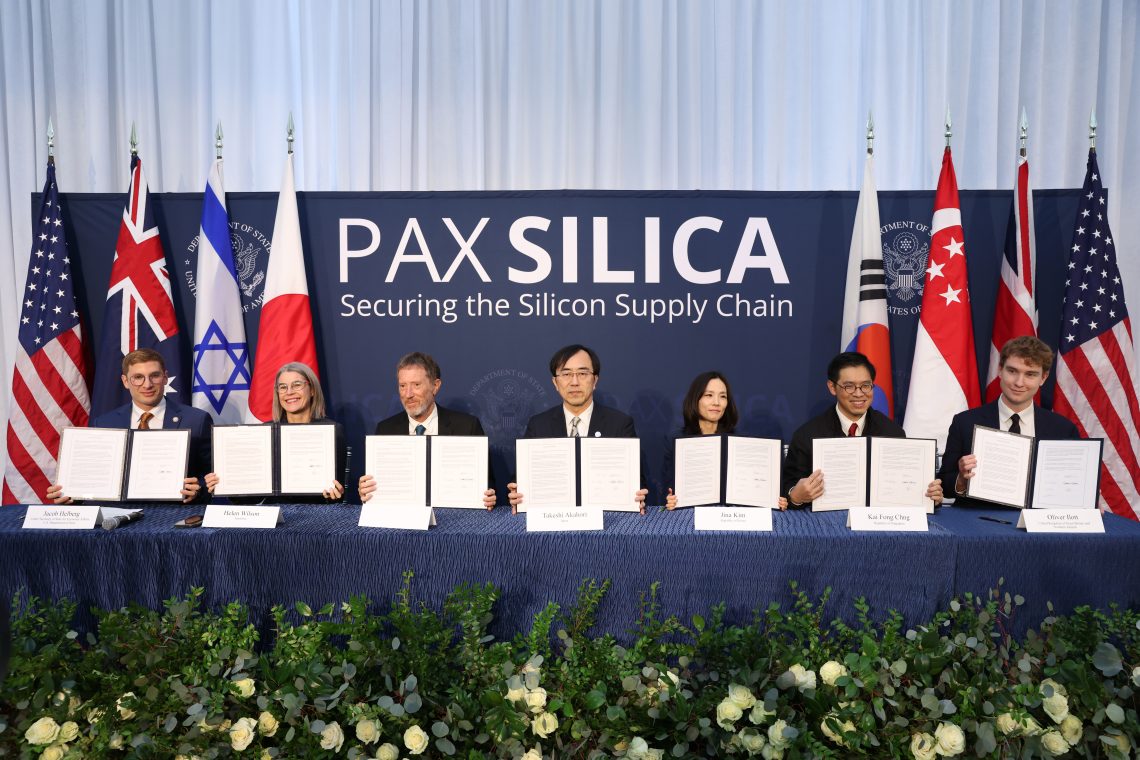
Pax Romana. Pax Britannica. Pax Americana. Each marked an era in which a dominant power underwrote order through control of the systems on which prosperity depended. In December 2025, Washington reached for this lineage again. With the launch of Pax Silica, the United States announced that the foundation of the global order had shifted. Power in the 21st century would no longer rest primarily on oil, steel or one nation’s aircraft carriers, but on compute (computational power), semiconductors and the minerals and infrastructure that sustain artificial intelligence at scale.
The symbolism was deliberate. When Jacob Helberg, the Under Secretary of State for Economic Growth, Energy, and the Environment declared that “if the 20th century ran on oil and steel, the 21st century runs on compute,” he was not merely describing a technological trend. Pax Silica is not an industrial policy program, nor a traditional alliance. It is an attempt to reorganize the technologies used globally around American-controlled chokepoints – and, in doing so, to redefine what alignment, sovereignty and dependence mean in the AI age.
For three decades after the Cold War, the U.S. approached global technology supply chains primarily as efficiency problems – optimizing for cost and scale while assuming geopolitical disruption was a tail risk rather than a design constraint.
That model unraveled in stages: first as China emerged as a strategic rival; then during the Covid-19 pandemic, which exposed how concentrated supply chains failed under stress; and finally with the recognition that advanced AI is not simply another digital service, but a general-purpose capability with direct military, economic and political consequences. Once AI came to be understood as an infrastructure of power, treating its supply chain as a neutral market outcome became untenable.
Pax Silica represents the most explicit break yet with the post-1990s era. Rather than attempting to reshore everything – a task that is economically infeasible – the U.S. is pursuing something more selective: control over the narrow points where the entire system can be constrained. Scale matters, but chokepoints matter more.
Scale matters, but chokepoints matter more.
This logic explains the otherwise puzzling composition of the early signatories. Japan, South Korea, Singapore, the United Kingdom, Australia, Israel, Qatar and the United Arab Emirates are not the world’s largest economies. Nor do they constitute a classic Atlantic or Indo-Pacific alliance. Instead, each occupies a position either indispensable to, or strategically complementary with, the AI supply chain.
Pax Silica is a coalition of nodes, and not all are equal. South Korea and the Netherlands (a non-signatory partner) control genuine chokepoints – inputs (memory and machinery, respectively) without which the global AI system cannot function. Others contribute strategic depth. The UK offers semiconductor and software design company ARM’s chip architecture and Europe’s largest venture ecosystem. Gulf states provide energy and sovereign capital. Singapore offers trusted logistics. Israel, home to major Nvidia and Intel design centers, brings chip design expertise, alongside defense-AI integration and a diplomatic bridge to Gulf partners through the Abraham Accords. The logic is complementarity, not symmetry.
Much of the public debate about semiconductor geopolitics fixates on fabrication, understandably since Taiwanese technology firm TSMC produces roughly 90 percent of the world’s most advanced logic chips. Yet Taipei is not a signatory to Pax Silica, though it has endorsed the Pax Silica declaration principles. The exclusion is partly diplomatic, a consequence of the One China Policy. But it also reflects a deeper logic: Pax Silica is not primarily about who manufactures chips. It is about assembling control over whichever nodes currently constrain AI scaling – equipment, memory, energy, capital, regulatory alignment – and adapting as these constraints shift.
Consider memory. High Bandwidth Memory (HBM), the specialized chips that feed data to AI accelerators, is today’s tightest bottleneck. Two South Korean firms, SK Hynix and Samsung, control over 95 percent of production, with supply sold out through 2026. In December 2024, U.S. export controls explicitly targeted HBM for the first time. This helps explain why Seoul is a founding signatory while Taipei sits outside. South Korea holds the chokepoint that currently binds.
No country illustrates this logic more clearly than the Netherlands. Home to ASML, the sole producer of extreme ultraviolet lithography machines, the Netherlands holds a monopoly over a tool without which no advanced chip can be manufactured.
And yet, the Dutch declined to sign. They joined as non-signatories only after intense bilateral engagement with Washington. The hesitation reflected domestic concerns about subordinating industrial policy in a European Union member state to U.S. priorities. But the more important signal lay in how President Donald Trump’s administration handled the issue.
Washington did not negotiate through Brussels. It dealt directly with The Hague. A fragmented Europe is easier to manage than a coherent one, particularly when export controls are central to the strategy. Pax Silica thus reflects a broader American preference for bilateralism over supranational coordination.
The result is a paradoxical Europe: indispensable in practice, peripheral in form. ASML, one of the most important suppliers to the semiconductor industry, is critical. ARM underpins most chip designs. Germany hosts major data centers and AI “factories.” Yet the EU remains an observer, not a co-architect.

The EU’s exclusion is not simply geopolitical. It signifies deep “differences on how to approach cutting-edge technologies, particularly software and artificial intelligence,” as Under Secretary Helberg said in January 2026. Pax Silica presupposes a permissive environment for frontier AI development. The EU AI Act, by contrast, embeds precaution and mandatory obligations into AI governance.
To join Pax Silica is to accept American assumptions about how quickly AI should be deployed and who sets the rules.
From Washington’s perspective, this is a strategic liability. In a world where compute scale and iteration speed determine leadership, regulation becomes constrictive industrial policy by other means. To join Pax Silica is to accept American assumptions about how quickly AI should be deployed and who sets the rules. Brussels, for now, is either unwilling or unable to do so.
One of Pax Silica’s most novel elements is the integration of Gulf states into a high-technology alliance. Qatar and the UAE do not manufacture chips or design AI models. What they do offer is cheap, reliable energy at an industrial scale, combined with sovereign capital for data-center infrastructure.
Modern AI training consumes electricity on a scale previously associated with aluminum smelting. As compute becomes the new oil, energy geography reasserts itself. By incorporating Gulf states, the U.S. is arbitraging geography – pairing American model leadership with Middle Eastern power and capital.
By embedding Israel and Gulf states within the same framework, Pax Silica extends the Abraham Accords into the digital domain.
The political implications are equally significant. By embedding Israel and Gulf states within the same framework, Pax Silica extends the Abraham Accords into the digital domain. India, which became a signatory on February 20, adds manufacturing scale, reinforcing the pattern of assembling complementary nodes.
Despite its rhetoric, Pax Silica is explicitly non-binding. Critics have seized on this as evidence that it is largely symbolic. That critique misses the point. The real power lies in the informal hierarchy it creates.
The system distinguishes between allies – embedded in the “stack” (or pool of technological participants), co-designing and co-governing AI infrastructure – and clients, who access chips and services under rules set elsewhere, and are subject to revocation. In this sense, Pax Silica functions less like a trade bloc and more like an operating system. Washington writes the kernel – the program at the core of a computer’s operating system that always has complete control over everything in the system – and others run applications.
The asymmetry is sharpened by American carve-outs. While partners align on export controls, U.S. firms retain flexibility – Nvidia continues limited sales to approved Chinese customers, subject to fees.
Beijing understands the threat. Pax Silica is not a blockade, but a containment architecture – one that raises the cost of China’s technological ascent. Beijing’s response has been asymmetric: export controls on gallium, germanium and graphite (critical, high-performance materials essential to the infrastructure powering AI); expansion of its Unreliable Entity List; rhetorical framing of Pax Silica as decoupling under another name.
These moves expose mutual vulnerability. China produces 98 percent of the world’s gallium and 60-70 percent of its germanium. Pax Silica bets that chokepoint control over AI compute outweighs exposure on upstream materials. Whether that holds depends on how quickly alternative supply chains develop – and whether Beijing escalates before they mature.
Scenarios
The coalition survives its stress tests. The declaration evolves into operational coordination: harmonized export controls, joint investment screening and coordinated responses to Chinese pressure. India has recently joined, increasing the likelihood of this scenario. The EU AI Act undergoes quiet revision as member states seek bilateral accommodation. By 2028, Pax Silica functions as a de facto governing board for AI infrastructure.
The coalition proves too brittle. South Korea and Japan chafe at export controls that cost them Chinese market share while American firms retain carve-outs. Gulf states hedge with parallel partnerships with Beijing. Without binding commitments, coordination atrophies. The declaration becomes a symbolic artifact.
The Pax Silica coalition neither consolidates nor collapses – it stratifies. A core inner circle (the U.S., South Korea, Japan, the Netherlands and the UK) maintains tight coordination on chokepoints. Broader members participate loosely. The EU remains outside but increasingly reliant on Pax Silica for frontier AI access. The result is a layered system – more durable than a declaration, less coherent than a bloc.
Regardless of which of these scenarios materializes, the main takeaway is that Pax Silica is best understood as scaffolding rather than a finished structure. Its durability depends on whether symbolic alignment translates into sustained investment and political discipline across administrations.
What is already clear is that the era of benign technological globalization is over. Silicon has become strategic terrain. Like its predecessors, Pax Silica promises order. Whether it delivers stability, or merely a more brittle hierarchy, will be one of the defining questions of the AI age.
Contact us today for tailored geopolitical insights and industry-specific advisory services.
Sign up for our newsletter
Receive insights from our experts every week in your inbox.
Information about what personal data we collect about you and how we process it (including information about how we personalize our website for you and deliver content tailored to you) can be found in our privacy policy.

