
04-20-2026 05:20 AM CET | IT, New Media & Software
Introduction
The Cyber Insurance Market has emerged as a critical component of enterprise risk management as organizations face escalating cyber threats and financial exposure. Cyber insurance provides financial protection against losses resulting from data breaches, ransomware attacks, network disruptions, and regulatory penalties. With digital transformation accelerating across industries, businesses are increasingly prioritizing cyber resilience, driving substantial demand for insurance solutions tailored to evolving cyber risks.
Get Free PDF Sample Request: https://www.credenceresearch.com/report/cyber-insurance-market#request_sample
Market Overview
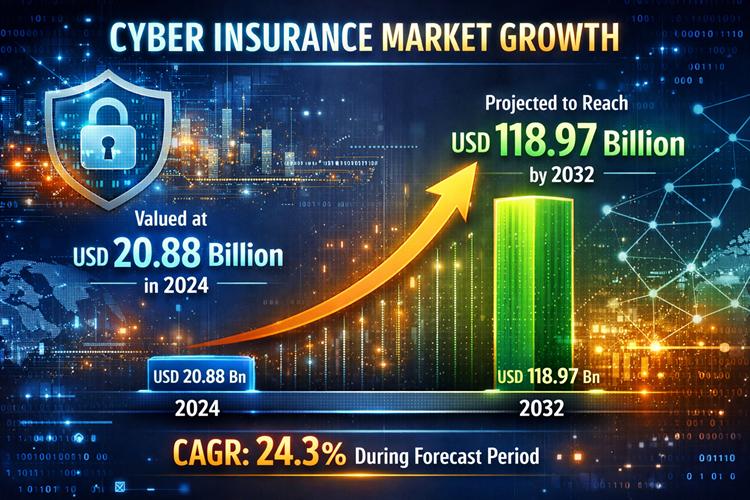
The Cyber Insurance Market was valued at USD 20.88 billion in 2024 and is anticipated to reach USD 118.97 billion by 2032, expanding at a robust CAGR of 24.3% during the forecast period. This remarkable growth reflects the rapid increase in cyberattacks, rising awareness of financial liabilities, and the growing importance of risk transfer mechanisms.
Organizations across sectors are recognizing cyber insurance not just as a financial safeguard but as a strategic tool to strengthen cybersecurity posture. Insurers are increasingly bundling coverage with risk assessment tools, incident response services, and continuous monitoring capabilities, making cyber insurance an integrated risk management solution rather than a standalone product.
Browse the full Report at https://www.credenceresearch.com/report/cyber-insurance-market
Market Dynamics
Drivers
The primary growth driver for the Cyber Insurance Market is the surge in ransomware attacks and data breaches. Organizations face substantial financial losses from operational downtime, legal liabilities, and reputational damage. Financial services institutions, which hold approximately 38% of the market share, remain the most targeted due to their sensitive data and regulatory obligations.
Additionally, stricter data protection regulations worldwide are compelling organizations to adopt cyber insurance policies. Compliance requirements in sectors such as healthcare and finance are significantly increasing the uptake of comprehensive coverage plans.
Trends
A key trend shaping the market is the integration of AI-driven underwriting models. Insurers are leveraging advanced analytics to evaluate risk profiles more accurately, enabling dynamic pricing and customized policy structures. Automated threat scoring systems are helping insurers assess vulnerabilities in real time, enhancing underwriting precision.
Another emerging trend is the bundling of cybersecurity services with insurance offerings. Insurers are partnering with cybersecurity firms to provide proactive threat detection, incident response, and risk mitigation solutions, creating a more holistic value proposition for clients.
Restraints
Despite strong growth, the market faces challenges such as rising claim ratios and increasing underwriting complexity. The frequency and severity of cyberattacks have led insurers to tighten policy terms, increase premiums, and impose stricter eligibility criteria.
Moreover, the lack of standardized risk assessment frameworks and evolving threat landscapes make it difficult for insurers to accurately predict potential losses, creating uncertainty in pricing models.
Market Segmentation
By Application
The Cyber Insurance Market is segmented into financial services, healthcare, retail, and manufacturing. Among these, financial services dominate due to high exposure to cyber risks and stringent regulatory requirements. Healthcare is another rapidly growing segment, driven by increasing digitalization of patient records and rising cyber threats targeting healthcare infrastructure.
Retail and manufacturing sectors are also witnessing growing adoption as they expand their digital operations and supply chain networks, increasing vulnerability to cyber incidents.
By Coverage Type
Based on coverage type, the market includes network security liability, data breach response, business interruption, and privacy liability. Data breach response coverage is highly sought after, as organizations aim to mitigate financial losses associated with data leaks and compliance violations.
Business interruption coverage is gaining traction as cyber incidents increasingly disrupt operations, leading to significant revenue losses. Privacy liability coverage is also critical, especially in regions with stringent data protection laws.
By Deployment
The market is divided into cloud-based and on-premises deployment models. Cloud-based solutions dominate due to their scalability, flexibility, and ability to support real-time monitoring and analytics. As organizations migrate to cloud environments, insurers are adapting their offerings to address cloud-specific risks.
On-premises deployment remains relevant for organizations with strict data control requirements, particularly in regulated industries such as finance and government.
By Geography
Geographically, the Cyber Insurance Market is segmented into North America, Europe, Asia Pacific, Latin America, and the Middle East & Africa.
North America leads the market with approximately 38% share, driven by high awareness, advanced cybersecurity infrastructure, and stringent regulatory frameworks.
Europe follows with around 28% share, supported by strong data protection regulations and increasing adoption across enterprises.
Asia Pacific, holding nearly 22% share, is the fastest-growing region due to rapid digitalization, expanding IT infrastructure, and rising cyber threats.
Latin America and the Middle East & Africa are gradually adopting cyber insurance, driven by increasing awareness and regulatory developments.
Get Free PDF Sample Request: https://www.credenceresearch.com/report/cyber-insurance-market#request_sample
Competitive Landscape
Munich ReGroup or Munich Reinsurance Company, Zurich Insurance Company Limited, Lockton Companies Inc., Berkshire Hathaway Inc., AXA XL, Lloyd’s of London, American International Group Inc., Chubb Limited (ACE Limited), Allianz Group, AON Plc
The Cyber Insurance Market is highly competitive, with major players focusing on expanding their global presence and enhancing service offerings. Leading insurers are investing in advanced analytics, AI-driven underwriting, and strategic partnerships with cybersecurity firms to strengthen their market position.
Companies are also expanding their incident response networks to provide rapid support during cyber events. This includes collaborations with forensic experts, legal advisors, and IT security specialists to deliver comprehensive post-breach services.
Additionally, insurers are adopting stricter underwriting standards to manage rising claim costs. Premium adjustments and policy refinements are becoming common as companies strive to balance profitability with risk exposure.
Regional Analysis
North America
North America dominates the Cyber Insurance Market due to its mature insurance industry and high adoption of digital technologies. The presence of leading insurers and strong regulatory frameworks further supports market growth. Organizations in the region are highly aware of cyber risks, leading to widespread adoption of comprehensive insurance policies.
Europe
Europe holds a significant share, driven by stringent data protection laws such as GDPR. Enterprises across the region are increasingly investing in cyber insurance to comply with regulations and mitigate financial risks associated with data breaches.
Asia Pacific
Asia Pacific is experiencing rapid growth due to increasing digital transformation and rising cyber threats. Countries such as China, Japan, and India are witnessing strong demand for cyber insurance as businesses expand their online operations and regulatory frameworks evolve.
Latin America
Latin America is gradually adopting cyber insurance solutions, supported by growing awareness and increasing cyber incidents. Businesses in the region are recognizing the importance of risk transfer mechanisms to safeguard against financial losses.
Middle East & Africa
The Middle East & Africa region is witnessing steady growth, driven by digitalization initiatives and increasing cybersecurity investments. Governments and enterprises are focusing on strengthening cyber resilience, boosting demand for insurance solutions.
Future Outlook
The future of the Cyber Insurance Market looks highly promising, with continued growth driven by increasing cyber threats and evolving regulatory landscapes. Insurers are expected to further integrate advanced technologies such as artificial intelligence, machine learning, and blockchain to enhance risk assessment and claims management processes.
The shift toward predictive and preventive insurance models will redefine the market, enabling insurers to proactively identify risks and reduce the likelihood of cyber incidents. Additionally, the expansion of cyber insurance into small and medium enterprises (SMEs) will open new growth opportunities.
Conclusion
The Cyber Insurance Market is undergoing rapid transformation, driven by the growing complexity of cyber threats and the increasing need for financial protection. With strong growth projections, technological advancements, and expanding adoption across industries, the market is set to play a pivotal role in global risk management strategies.
As organizations continue to embrace digital transformation, cyber insurance will become an essential component of business continuity planning, ensuring resilience in an increasingly interconnected world.
Browse the full Report at https://www.credenceresearch.com/report/cyber-insurance-market
Contact US:
Credence Research Inc, Tower C-1105 , S 25, Akash Tower,
Vishal Nahar, Pimple Nilakh, Haveli,
Pune – 411027, India
India – +91 6232 49 3207
sales@credenceresearch.com
www.credenceresearch.com
About US:
Credence Research is a leading international provider of market intelligence and a key component in the due diligence process. We deliver high-quality, extensive, deep-dive reports that empower leaders and investors to make informed decisions and mitigate risks. Our strategic insights, based on extensive research frameworks and advanced data modeling, provide authoritative primary sources for evaluating market performance and potential across a wide range of industries.
This release was published on openPR.

