
Refugee movements, migration flows and forced displacement continue to accelerate at an unprecedented scale, driven by protracted conflict, political instability and weakening global conflict-prevention mechanisms.
According to the United Nations High Commissioner for Refugees (UNHCR), the total number of forcibly displaced people worldwide has exceeded 117 million, encompassing refugees, asylum seekers and internally displaced persons.
In Middle East countries such as Palestine, Lebanon and Iran over the past month, escalating conflict has forced families to flee their homes, including many already living as refugees, leaving them with no safe place to go.
The number of registered Palestinian refugees has reached approximately 5.9 million, according to the recent data from the United Nations Relief and Works Agency (UNRWA), reflecting a significant increase from the roughly 750,000 people the agency initially assisted in 1950.
These refugees are distributed across five main areas of operation. The largest population is in Jordan, with around 2.3 million registered individuals.
This is followed by the Gaza Strip, where between 1.47 million and 1.6 million reside, and the West Bank, with approximately 800,000 to 900,000.
Smaller populations remain in Syria, at around 438,000, and Lebanon, where estimates range between 250,000 and 500,000.
Despite the scale of displacement, only about one-third of registered refugees, roughly 1.5 million, live in UNRWA’s 58 recognized camps, while the majority reside in urban areas and surrounding communities.
In Lebanon, recent U.N. and humanitarian monitoring indicate that over 1.2 million people have been displaced since the escalation in March.
According to UNHCR, up to 3.2 million people have been temporarily displaced within Iran as a result of the ongoing conflict escalation, though precise displacement totals remain subject to verification across sources.
These figures and recent developments framed discussions at the Antalya Diplomacy Forum, which hosted a panel titled “Global Refugee Protection System in the Face of Displacement Crisis,” on Friday, examining the growing strain on international protection mechanisms.
Talks focused on funding gaps, political will, and the effectiveness of existing legal frameworks.
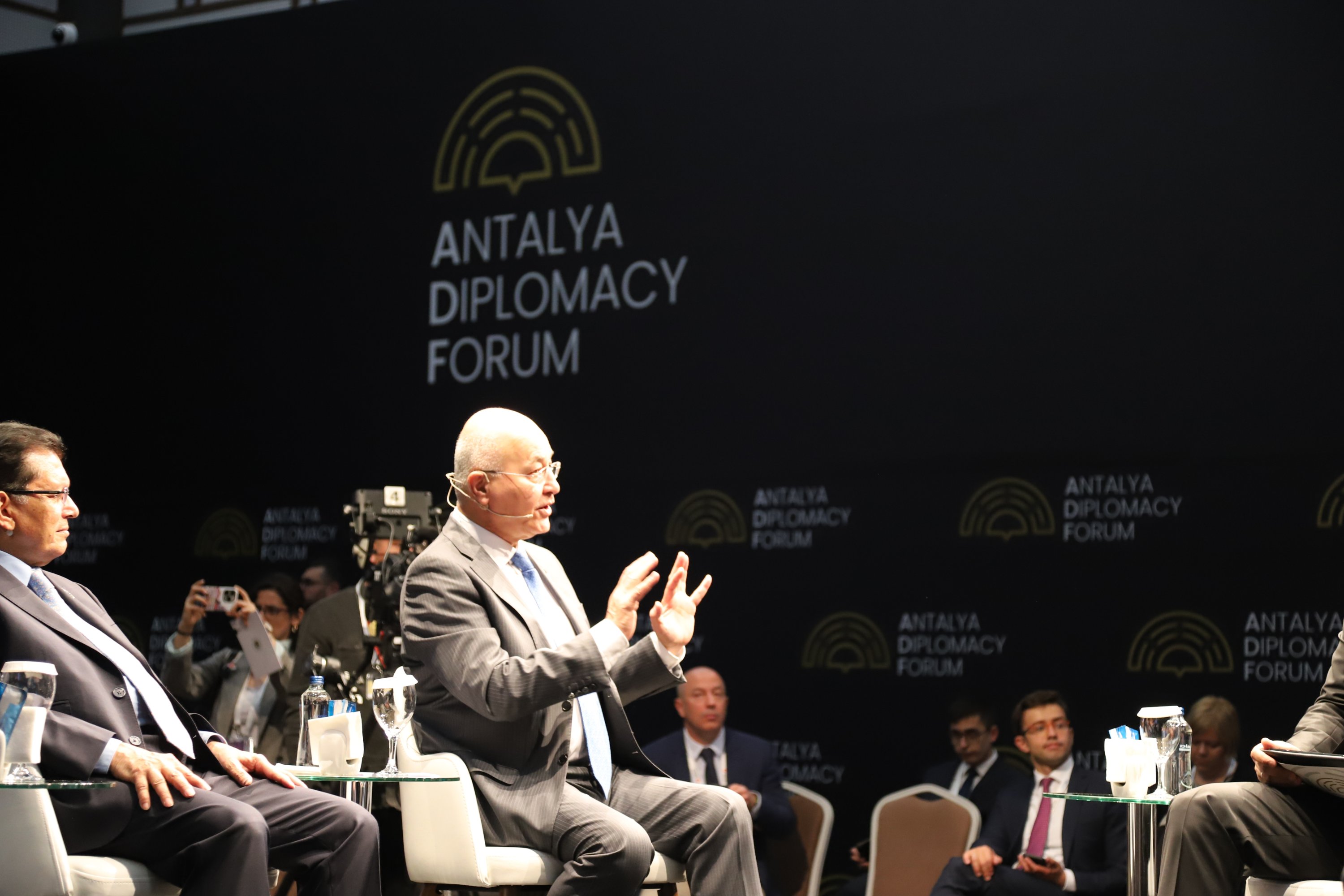
Responding to these challenges, Barham Salih of UNHCR emphasized that the crisis cannot be reduced to a single reform, describing it as multidimensional and structural.
He also highlighted Türkiye’s role as one of the world’s largest refugee-hosting countries, noting its sustained response, particularly since the Syrian crisis.
He stated, “Türkiye stands out as an important example in refugee hosting. This country has been hosting unprecedented numbers of refugees from Syria, and before that and during that period, refugees from other communities, including Iran and Afghanistan.”
He pointed to the scale and duration of the Syrian refugee presence, “Nearly 4 million Syrian refugees were in Türkiye. Today, around 2.3 million remain.”
Salih said the scale of hosting strained national systems, especially in the early crisis period amid difficult political, social, and economic conditions, “This was not easy at the time politically, socially, or economically, but Türkiye stepped up and hosted these communities at their time of need.”
He used Türkiye’s experience to illustrate the broader burden carried by front line host countries within the global refugee system, particularly in contexts where displacement becomes prolonged and international responsibility-sharing remains uneven.
Salih explained the crisis cannot be addressed through isolated reforms due to its scale and complexity, stressing the need for increased funding amid rising displacement and shrinking humanitarian resources.
He pointed to strained conditions in host countries, citing Chad, where large refugee populations face severe economic constraints. He noted that humanitarian agencies, including UNHCR and partners, face severe funding gaps affecting basic services.
Salih stated, “With current funding levels, we are only able to provide 9 liters of water per person per day, far below minimum emergency standards.” He added that while efficiency can improve, the core issue is structural underfunding.
This means in some places, chronic shortages have reduced access to even basic necessities, forcing people to make difficult choices between using limited water for cooking, washing, or basic hygiene.
The World Health Organization (WHO) recommends a minimum of 15 to 20 liters of water per person per day for basic survival and sanitation, a threshold that many crisis-affected communities are falling well below.
A key concern highlighted was the scale of protracted displacement, with two-thirds of refugees globally reliant on long-term humanitarian assistance. “Two-thirds of refugees today are in protracted displacement, meaning they remain in such conditions for five years or more. In some cases, this extends to decades, as seen among Rohingya and other populations.”
Countries such as Chad, Kenya, Ethiopia, and Uganda were cited as examples of relatively progressive inclusion policies, though their financial and institutional capacities remain limited.
“These countries are highly constrained and cannot carry this responsibility alone. There must be global responsibility-sharing, with development assistance directed toward job creation, infrastructure, and economic resilience so that refugee hosting becomes an asset rather than a burden,” he said.
Salih called for closer coordination with the World Bank, International Monetary Fund, and International Finance Corporation to support refugee integration, while urging expanded legal pathways to reduce irregular migration.
Citing Syria, he pointed to delayed international responses as a factor that intensified displacement, arguing that earlier action could have reduced humanitarian consequences.
Durable solutions, he said, depend on prioritizing peace, reconstruction, and sustained development investment in fragile states, with stability seen as essential for voluntary returns.
He warned against the politicization of displacement, noting that refugees and migrants are often negatively framed in public discourse, and called for a more balanced narrative.
Displaced populations, he stressed, also contribute economically and socially to host countries, citing Ukrainian refugees in Poland as an example of measurable impact.
Most displaced people, he added, ultimately aspire to return home when conditions allow, underscoring that displacement is rarely a voluntary choice.
Particular concern was also raised over the disproportionate impact on women and girls, especially in conflict settings, where vulnerability and protection risks are significantly heightened.

