
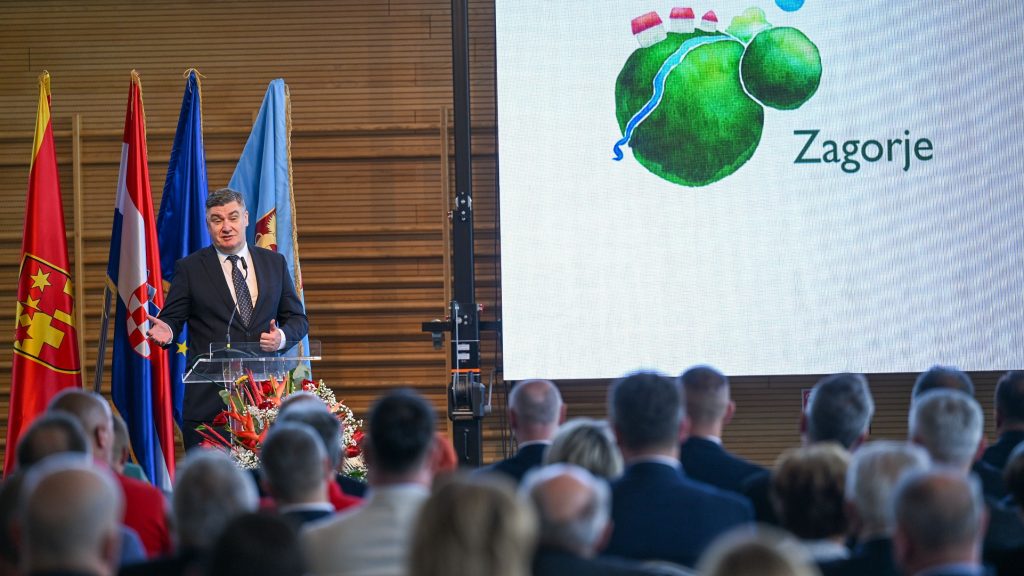
(Photo: Office of the President of Croatia/Filip Glas)
Croatian President Zoran Milanović has warned that Croatia must remain cautious amid rising global tensions, stressing the importance of avoiding involvement in conflicts that do not serve the country’s interests.
Speaking at a ceremonial session marking Krapina-Zagorje County Day, Milanović highlighted growing instability in regions such as Iran and the Gulf, as well as what he described as uncertain strategic direction within the European Union.
Quoting a well-known military principle that a good plan does not guarantee success, but no plan guarantees failure, the president said current global developments reflect confusion and missteps, including within the EU’s evolving defence ambitions.
Milanović argued that the European Union, originally founded as a peace and trade project, is gradually shifting away from its core purpose.
He noted that while the bloc remains economically strong and largely self-sufficient in food production, it no longer operates solely as a project of peace and security.
“The question is what path the European Union is now taking and what it is arming itself for,” he said, describing these as fundamental issues for member states, including Croatia.
The president emphasised that Croatia today does not have a clear external enemy, despite ongoing unresolved relations with Serbia.
Beyond that, he said, Croatia is in a historically unique position of not facing direct threats, making it all the more important to avoid being drawn into broader geopolitical conflicts.
He stressed that Croatia has both the right and the necessity to pursue an independent foreign policy based on its own judgement and interests. “We must decide where to engage and where to step back,” he said, adding that such an approach is essential for the country’s long-term stability and security.
Turning to economic matters, Milanović warned that Croatia’s trade balance remains weak and requires urgent attention. He also pointed to challenges ahead as EU funding mechanisms, including the National Recovery and Resilience Plan, begin to wind down.
According to the president, maintaining current levels of public spending growth will likely require additional borrowing in the coming years, a strategy he described as unsustainable in the long term.

