

Concerns around fraught supply chains and geopolitical tensions are giving rise to demands for ‘sovereign AI’, as nations seek to develop and deploy the technology, without being reliant on overseas providers for support. A new study from Accenture suggests six-in-ten firms investing in technology are now more likely to seek ‘sovereign’ solutions – but warns that this may also hold back innovation.
Sovereign AI refers to the ability of a country to develop and deploy AI using local infrastructure, data, models and talent to protect data from foreign access, bolster competitiveness, and decrease reliance on overseas technology providers. And amid a wave of cyber-attacks, which use companies’ suppliers and partners to find weaknesses, it is not hard to see why it might sound like a safer option for organisations adopting AI tools.
Adding to this, some attacks have allegedly been committed by groups with links to hostile states; while other nations have openly explored the opportunities for surveillance of friends and foes that the implementation of new technology offers up. As a result, uptake among European organisations for sovereign AI is on the rise.
Source: Accenture Sovereign AI survey
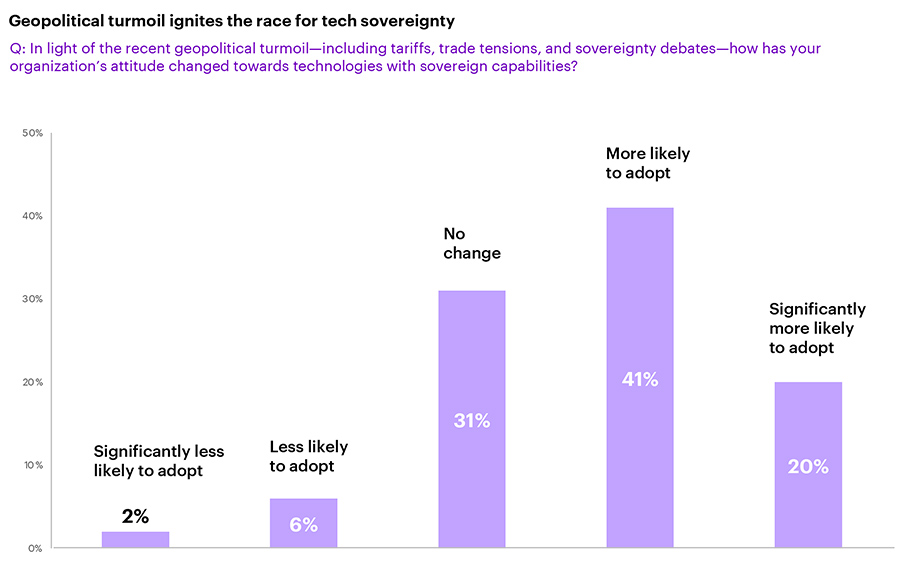
A new study by Accenture, of almost 2,000 organisations, has found that European entities are placing greater emphasis on maintaining control over data and infrastructure. In Europe, 61% of organisations now feel they are more likely to adopt sovereign solutions in response to current geopolitical uncertainty, trade tensions, tariffs and political interference.
Among those, 41% said they were more likely, while 20% said they were significantly more likely. In contrast, just 8% said they were in any way less likely to adopt sovereign solutions. These concerns were particularly elevated in certain European nations, too. An 80% majority of Danish respondents said they were turning to the technology, while in Ireland and Germany 72% said the same thing.
At the same time, sectors with heightened regulatory requirements and sensitive data were more likely to lead sovereign AI adoption. When assessing the maturity of sectors in applying AI sovereignty, Accenture found – perhaps unsurprisingly – that aerospace and defence led the way, closely followed by government and public sector work. Meanwhile, the Nordics, Germany, Switzerland and the UK were all seen as leading when it comes to placing residency and sovereignty requirements on their technology. However, for private sector entities in particular, Accenture’s experts suggested this may be a double-edged sword.

Source: Accenture Sovereign AI survey
Mauro Macchi, Accenture CEO for EMEA commented, “Europe is facing an AI paradox. Its leaders understand the need to accelerate AI adoption to spur innovation and drive growth. But at the same time, because most AI technologies originate from outside the region, it could also be seen as a risk. A sovereign AI approach can help resolve this challenge by enabling European organisations to protect critical operations without hampering innovation and competitiveness. It’s with an innovative and thriving economy that we’ll be able to invest in strengthening our technology ecosystem, enabling local champions to grow and compete on the global stage.”
This is something many European organisations seem to acknowledge. Only 19% of organisations view sovereign AI as a competitive advantage, while 48% cite compliance requirements as their primary motivation for adopting sovereign solutions. Seeking a balance between data control and access to global innovation, 65% of respondents added that they feel they cannot remain competitive without non-European technology providers.
Mauro Capo, digital sovereignty lead for Accenture in EMEA added, “A sovereign AI approach is not about holding everything in one place. The goal is to make technology choices according to the degree of control organisations want to exercise over data, AI infrastructure and models, while benefiting from the scale, service breadth and pace of innovation that some non-European providers offer. These choices are decided by the use case and national priorities. Some cases need only local data residency, while others, in defence for instance, call for full sovereignty over the different AI components – local data, infrastructure and model, advanced encryption, or even air-gapped systems when necessary.”

