
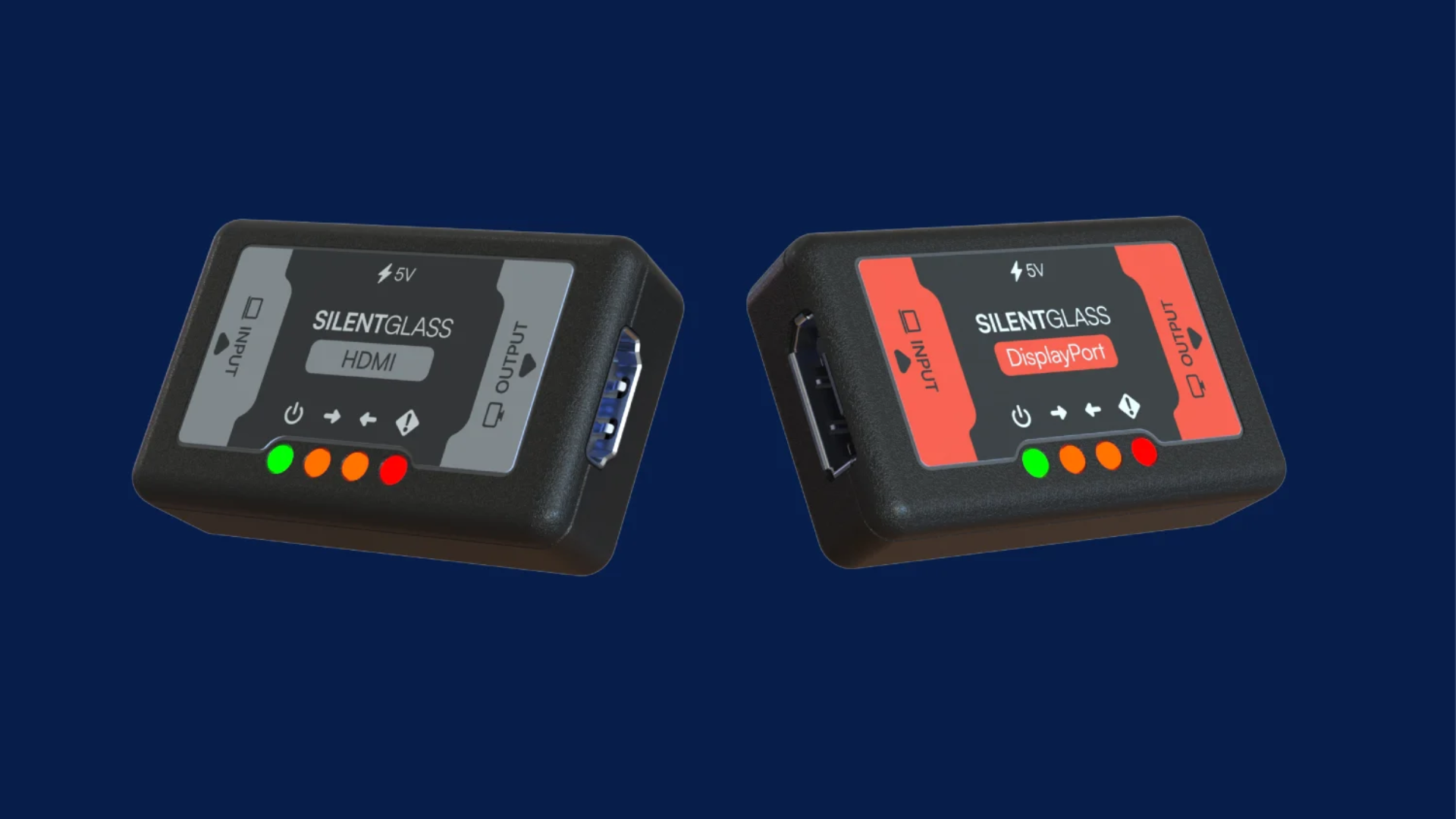
The UK’s Government Communications Headquarters (GCHQ), a counterpart to the U.S.’s National Security Agency (NSA), just launched SilentGlass through the National Cyber Security Center (NCSC). This little gadget was announced during CYBERUK, a government-sponsored cyber security conference, and is designed to block malicious traffic traveling between a display and a PC. According to the NCSC, it built and designed this plug-and-play device to protect government estates and has been “approved for use in the most high-threat environments.”
The government has since licensed the design to Goldilock Labs, a UK-based cybersecurity firm that specializes in hardware that automatically cuts physical connections during a cyberattack, limiting potential damage to a network. It has partnered with Sony UK Technology Center to make the product available globally, although the firm has yet to put the product publicly available on the market.
Article continues below
While SilentGlass is an interesting security device, some information security experts question the actual need for it. Cybersecurity expert Scott McGready said on X, “Can anyone genuinely tell me what risk this is addressing or is it a solution in search of a problem?” After all, most common cyberattacks do not use video signals as an attack vector. Nevertheless, that does not mean that it’s impossible to take advantage of HDMI and DisplayPort to exfiltrate information.
Way back in 2020, a research paper revealed a technique which subtly changed monitor brightness to steal data from air-gapped PCs, while a more recent study showed that AI can use signals leaking from HDMI cables to reconstruct what the target computer is displaying. These aren’t likely problems for the billions of home and office computers around the globe, as these techniques are complicated and would often cost more to deploy than the potential data they can gather from the average civilian.

Follow Tom’s Hardware on Google News, or add us as a preferred source, to get our latest news, analysis, & reviews in your feeds.

