


By Jason Lewis
Today people live in a cyber world.Automation has connected many daily tasks and systems that people rely on to various forms of technology, with most of those being connected to the Internet.The reliance on technology has led to the need for cybersecurity to protect systems, networks, and data from digital attacks.
“Anything that you can connect to the Internet, those things are vulnerable,” said Curtis Carpenter, senior information technology security analyst at California State Polytechnic University-Pomona. “We have them on the same home networks that we have our computers on that have our taxes. So it’s not something that only affects a few people or large businesses. This affects all of us.”
There is a large cybersecurity industry to ensure that people’s information is protected.Like many technology fields, there are more available jobs than people trained to do them, and Black professionals are underrepresented in those fields.
“Our world is increasingly becoming dependent on technology and as that happens, there’s going to continue to be a need for more and more qualified cyber professionals,” Carpenter said. “The unemployment rate for cyber professionals is extremely low, and it pays very well. Our ultimate goal is to see more African Americans and students of color in information technology or cybersecurity, as well as STEM overall.”
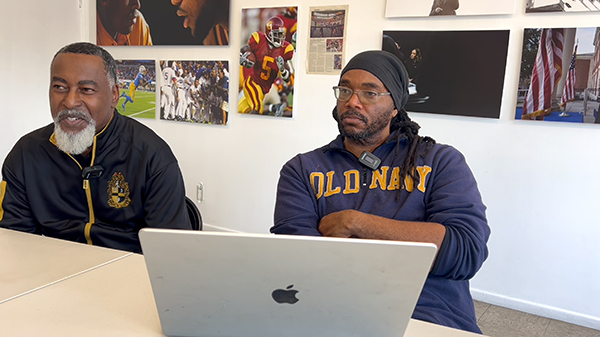
Carpenter and David Kinder, a cloud/automation engineer, have created a CyberPatriot team through their fraternity, Alpha Phi Alpha Fraternity, Inc., Iota Zeta Lambda Chapter (Compton), which meets at City of Hope LA in Inglewood.CyberPatriot is a national youth cyber education STEM program of the Air & Space Forces Association.It was created to inspire K-12 students toward careers in cybersecurity or other STEM disciplines critical to the nation’s future.CyberPatriot hosts cyber defense competitions and cyber camps.
The lack of Black professionals and students in technology fields begins with young students not having the same access as students from more affluent communities.
“The interesting thing about it is that there are schools in Los Angeles that have participated in it for years but you don’t often see schools that have demographics that have a lot of African American students participating,” Carpenter said.“It’s hard for them to aspire to be in a career if they don’t know that it exists.We want to expose them to that.And there aren’t a lot of African American professionals in the cyber industry and the IT industry as well in comparison to other ethnic groups.One of the ways that we want to change that is to try to expose them to this early through this program.”
The cyber program teaches the basic cyber principles and cyber defense.
“We focus on three major things,” Kinder said.“First, keeping things confidential.You have files on your computer that you don’t want people to have access to.Protecting that is a part of cybersecurity.Making sure that you have the right permissions on that and making sure that the right people have access to those things.Second, we focus on integrity.There are hackers out there who may not want to steal your data, but they want to change or delete your data.And the third thing is access to your systems.Who can log into your systems.”
Learning how to prevent hackers from gaining entry into systems is a large part of learning how to become a cybersecurity specialist.
“Hacking is offensive by nature,” Carpenter said.“A hacker is trying to get into something.For the students, we focus more on the defensive principles.Locking systems down, making sure that its configured properly to keep people out of systems, knowing who should have credentials, making sure that the environment is hardened so that you can keep threat actors out of the system.The infrastructure by the CyberPatriot organization is a series of systems, either Windows or Linux, that the students are given and they have to learn how to harden them.”
One of the great things about the cybersecurity profession is that there are a lot of unfilled jobs, making it easier than other professions to obtain employment.
“There are hundreds of thousands of jobs, cybersecurity positions, that are available right now,” Carpenter said.“In addition to that, not only are they open and available, when you look at the medium salary, those are very high paying jobs.If you have plenty of jobs that are open and available, but our students aren’t getting exposed to it, that’s an opportunity that our youth is missing.These are great careers with great salaries that can help sustain their future families.”
Many cybersecurity professionals receive college degrees in computer science, computer information systems, and computer engineering.Carpenter has coached collegian cybersecurity teams, and he has hired college students for IT assistants.He said that many of those students started their cybersecurity education before they made it to the college level.
“I was looking at resumes and I could see that they just graduated from high school, and their resume looks like somebody who has been in the IT field for three years,” Carpenter said.“That may even include professional certifications.I’d ask them how they were coming out of high school with all of these skills and certifications, and they told me that they did CyberPatriot while in high school.So they come into college with an advanced set of skills.They’re already ahead of the curve which puts them in positions for internships.I have a student who has been working at Boeing since he was a freshman, and that’s because he had this advanced skillset because he took this type of program all through high school.Those are the type of experiences that we want our students to have access to.”
For the children who are in this program, many of them entered without much technological experience, and they all showed massive improvement.
“One young lady had not done anything like this before,” Kinder said.“When faced with the challenges she was all in.It was more of a puzzle that she had to figure out.She learned all of the concepts and techniques so that she could figure out this puzzle.While doing that, she learned a new skillset that she’ll be able to use in the future.It’s amazing as a trainer to see this happen because as we’re going over the material, we don’t know if it’s really sticking.But in the moment when they’re in the competition, it’s amazing to see them do this.”
While many people in the industry have college degrees, it is not required as there are tech bootcamps that are certificate programs.
“Students can do self study for some of these certifications if they have the drive,” Kinder said.“They can use those certifications to get jobs right out of high school.You don’t have to necessarily go to college.You can pick up these certifications and get an entry-level position, then work your way up to a six-figure salary.”
Kinder also points out that he’s seen many people enter this field who came from unrelated professional fields, so making a career change is very possible.
For more information contact This email address is being protected from spambots. You need JavaScript enabled to view it.

