
On 18 December, the International Centre for Defence and Security (ICDS) was delighted to host a discussion on Russian cyber issues with Prof Kévin Limonier, Morvan Lallouet, and PhD student Olivier Royer.
Prof Limonier presented the work conducted at GEODE lab, a research institution studying the impact of digital transformation on the strategic environment. He mapped the different dimensions of cyberspace that illustrate Russian destabilisation phenomena. Olivier Royer gave a presentation on the digital border between NATO’s north-eastern flank and Russia.
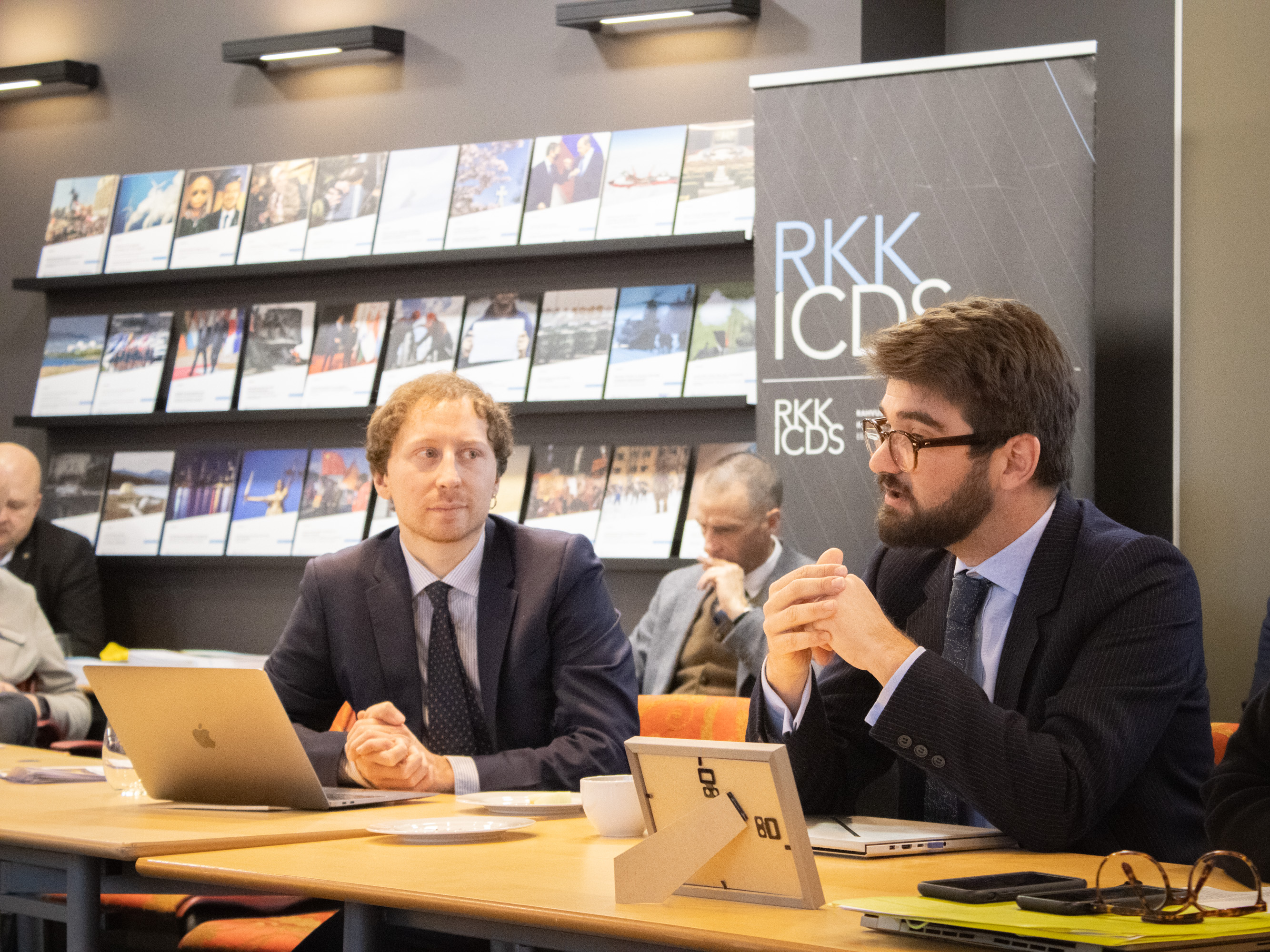
Morvan Lallouet gave an overview of CORUSCANT, a network for Russian studies, which aims at decentring and refocusing the field, advancing the dialogue with policymakers, building an international network for new Russian studies, and training Russia experts. The collective is developing an ambitious programme of digital tools in order to confront the problem posed by the inaccessibility of Russia. Its annual conference will be held in Berlin on 16 January 2026 together with ZOiS.

Kévin Limonier is a Professor at the University of Paris 8 and a specialist in Russian cyber issues. He is the deputy director of GEODE lab and the scientific director of the Russian-speaking infosphere observatory for the benefit of the French Ministry for the Armed Forces. His current focus is on the development of new methods for mapping cyberspace. More broadly, he is a specialist in the Russian-speaking internet and territorial innovation policies in the USSR and contemporary Russia.
Morvan Lallouet is a specialist in Russian politics, currently working at GEODE Lab, and project manager of Coruscant, a research collective on contemporary Russia. He is also a co-author of “Navalny: Putin’s Nemesis, Russia’s Future?” which was selected by the Financial Times as one of the politics books of the year 2021.
Olivier Royer is a PhD student working on the digital border between Russia and NATO in the northeast.

