
The current period is a crucial inflection point in world politics for many countries, including Arab states. It is today essential to ask whether leading Arab countries have been active players in the reshaping and remolding of the new world order or simply swept along by uncontrollable currents. Recent developments suggest that they have played both roles, albeit unevenly. What is missing in the Arab world and elsewhere is a bold vision for creating a world order that is altogether new. This challenge becomes especially clear when the question of Palestine is placed at the center of understanding geopolitics in the region.
The Old and the New World Orders
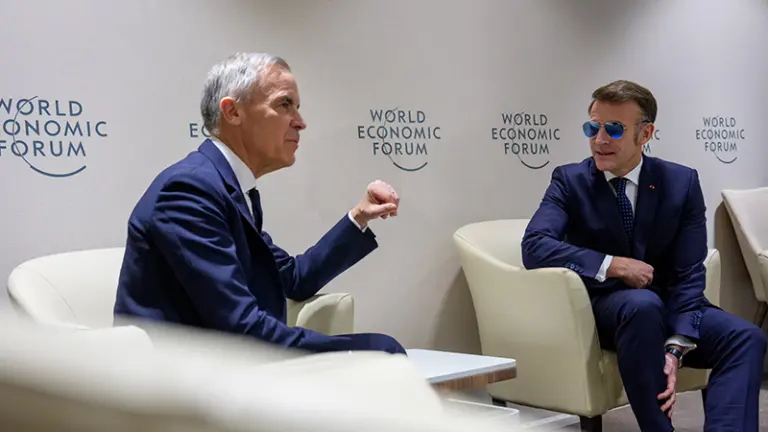
In a widely discussed speech at the 2026 World Economic Forum in Davos, Canadian Prime Minister Mark Carney announced that the rules-based international order was over. He openly acknowledged that the old order should not be mourned as it had never lived up to the universal application of rules and values, such as fair and free trade, human rights, accountability for those who transgressed the rules, and prosperity for all. Carney’s speech was essentially an admission that a veneer of liberal peace had concealed the true features of this order, which was constructed largely for the benefit of Western powers.
Carney pleaded for other states to join him in honestly naming the reality of the current world order and in working together to move beyond it. He counterposed his recommended approach against that of those leaders who are attempting to gain favor with the Trump administration, largely by appeasing the US president and appealing to his massive ego, in the hope—a fool’s hope in Carney’s view—of advancing their own narrow interests. But as Carney put it, in this world order, nations’ options are either sovereignty (power allows you a seat “at the table”) or subordination (lack of power puts you on “the menu”). Carney envisions the new world order as one in which middle powers create an economic, security, and political infrastructure that can help ensure the long-term production of capital by adhering to universal values and new rules.
Since no state can currently match US power, this is the time to brutally assert US military and economic strength.
Despite his hypocritical position—after all, his country helped enable the Gaza genocide—Carney’s critique of the appeasement strategy is correct. In response to US President Donald Trump’s global tariffs, economic warfare against many states, support for and active participation in Israel’s genocidal plans in Gaza, and military campaigns against Iran, Venezuela, Nigeria, and other countries, the world’s leaders and major institutions largely have adopted a policy of appeasement.
Carney is right to encourage middle powers to join together and face the United States head on, with a long-term plan of weakening the US grip on the international order. It is clear, though, that Carney was speaking mostly to European countries and “Western” states like Australia, Japan, and South Korea—not to the Global South, including Arab states. Moreover, many experts doubt that his vision is even feasible since weak states and middle powers alike are heavily dependent on US power, and have divergent interests.
The United States and the Arab States
The Trump administration has not changed the foundations of the US role in the Arab world as the dominant superpower shaping the security, politics, and economics of the region in accordance with its own interests. What his administration has done is to unmask the nature of the world order and US power. For example, one of the core US foreign policy interests described in Trump’s recent National Security Strategy is “to prevent an adversarial power from dominating the Middle East, its oil and gas supplies, and the chokepoints through which they pass while avoiding the ‘forever wars’ that bogged us down in that region at great cost.” Such language shows how the United States already views itself as the region’s dominant force, which must prevent an adversarial power (i.e., China) from competing with it. Much as it has done in other regions of the world, especially in Latin America, in the Arab region the Trump administration is no longer interested in concealing the brute reality of power politics with the visage of a liberal international order.
The Trump approach operates on the premise that the old order opened the door for US adversaries to use certain multilateral institutions against US interests. For example, countries from the Global South, including Arab states, have been attempting to use international law to hold Israel accountable for its crimes and to advance the Palestinian cause. But for the United States and its allies, international law was only built and supported in the first place to serve their interests, allowing for their clear double standards in its application. Indeed, the Trump administration prefers a world order where only might and power matter. And since no state can currently match US power, this is the time to brutally assert US military and economic strength in order to reestablish US supremacy.
Against this brute assertion of US power, and with the general disenchantment with a US-dominated world order, have Arab states managed to shift geopolitics so that regional powers become bigger players in determining the security, political, and economic trajectories of the region? As arguably the most powerful Arab state, Saudi Arabia has shifted its geopolitical strategy over the last few years away from total dependence on the United States. This shift began in the kingdom’s rapprochement with Iran and has continued with recent agreements such as a defense pact with Pakistan and growing economic and strategic relations with Turkey. At the same time, the United States remains indispensable for Saudi Arabia, as demonstrated in the enormous investments that the kingdom pledged to make in the US economy in 2025.
In the context of Carney’s assessment, such a show of plans for long-term and extravagant investment means that Saudi Arabia is appeasing Trump to advance its own interests. Such an approach could encourage the Trump administration to continue down the path of brute power politics, cementing “might-makes-right” as the principal logic of the new world order. Conversely, some of Saudi Arabia’s other policies suggest that it is trying to chart a different path in which regional players play a larger role in determining the future of their region, moving the international system toward regional multilateralism.
But how different is this path? For example, Pakistan, Saudi Arabia’s defense partner, is a close ally of the United States, and it too has adopted an appeasement strategy toward Trump. Both Pakistan and Saudi Arabia are part of the US security infrastructure in the region, which is designed to ensure US domination and supremacy. It is fair to ask, however, whether such alliances can help these states detach from US power eventually. This last question is not easily answerable, and such uncertainty makes it difficult to judge whether Arab states are active agents in shaping the new world order or if they are being swept along by stronger currents of history. The answer is that they are both.
This murky picture becomes clearer, however, when the question of Palestine is placed at the center of regional geopolitics. As Israel is the core element of the United States’ infrastructure of domination in the region, any strategy that is serious about reducing Washington’s firm grip on the region and the world order must deal with this basic fact and take actions to address it. Indeed, inaction on the question of Palestine becomes the main source of evidence that Arab states are not meeting the moment to become active players in shaping the new world order.
Palestine’s Sovereignty Denied
The Arab states’ long-held official position is that the Palestinian quest for statehood is central to their own core interests. This position was reiterated on September 5, 2025, in the Arab League’s Council of Foreign Ministers’ resolution that emphasized the importance of protecting the territorial integrity and sovereignty of Arab states, emphasized the critical importance of finding a just resolution for the Palestinian cause, and expressed a vision of mutual understanding and adherence to a policy of non-interference in other states’ internal affairs. On September 15, 2025, in the wake of Israel’s attack on Hamas leaders in Doha, Qatar, the Final Communique issued by the Arab-Islamic Emergency Summit there reiterated a commitment to the Palestinian cause. Beginning in June 2025 and leading up to September 2025, co-chairs Saudi Arabia and France organized the International Conference for the Peaceful Settlement of the Question of Palestine and the Implementation of the Two-State Solution, reaffirming the Palestinian people’s right to full self-determination as a key pillar of resolving conflict and ensuring stability and economic prosperity in the Middle East.
Israel’s impunity in Palestine reflects the region’s inability to develop its own geopolitical strategies and visions.
Two key takeaways from these resolutions and statements are that Arab and Organization of Islamic Cooperation countries’ primary concern is safeguarding their sovereignty, and that Israeli aggression against the Palestinian people constitutes the root cause of instability in the region. In fact, Arab and Islamic countries admit that Israel’s aggression against the Palestinians and colonization of Palestinian lands is tied to their own inability to protect their full sovereign rights. This reality is most evident in how, over the last several decades, Israel’s attacks with almost total impunity have violated the sovereignty of Egypt, Iran, Iraq, Jordan, Lebanon, Qatar, Syria, Tunisia, and Yemen. Of course, none of Israel’s actions are possible without US economic, military, and political support. The last two and a half years of genocide in Gaza have made even more obvious what was known for decades: Israel is an outpost for US power projection in the region and beyond. There is an implicit understanding in the Arab world that Israel’s impunity in Palestine reflects the region’s inability to develop its own geopolitical strategies and visions irrespective of any foreign power.
Disappointingly, these countries collectively continue to fall short in taking the necessary actions to protect their interests and shared vision, precisely because they are not taking steps to turn the Palestinian aspiration for sovereignty into a reality. The October 2025 Sharm el-Sheikh summit painfully illustrated how appeasement of Trump can only lead to the further colonization of Palestine, and highlighted the growth of Israel’s military supremacy in the region. In contrast, direct action means the severing of all diplomatic, economic, and cultural ties with Israel. This remains the missing piece that clarifies these uncertain times and suggests that what is coming is more likely to be a transition rather than a rupture with the old order. Only a bold vision and action can change the current trajectory.
A Truly New Order
What is needed is neither Trump’s “might-makes-right” logic nor Carney’s Eurocentric “new liberal rules-based order” agenda, but rather a democratic world order in which all states participate equally in the making of a truly new global economic, political, and security infrastructure. Middle powers such as Canada must themselves choose an alliance with Global South states. Some of these states, including those in the Arab world, are emerging or, like Saudi Arabia, are already middle powers. Others, like China, already are great powers in their own right. These countries should seize the moment, assume a leadership role, and establish a large coalition of states, including weaker ones that have been prohibited from achieving self-determination, such as the State of Palestine.
Openings in history do not come about often. Now is the time to act to change the world order in fundamental ways. All that is needed is a dedicated will and a brave aspiration to inaugurate the new order. What is at stake is not just Palestinian sovereignty and freedom, but the freedom and sovereignty of all Arab nations, and indeed those beyond the region.
The views expressed in this publication are the author’s own and do not necessarily reflect the position of Arab Center Washington DC, its staff, or its Board of Directors.
Featured image credit: X/Prime Minister of Canada

