
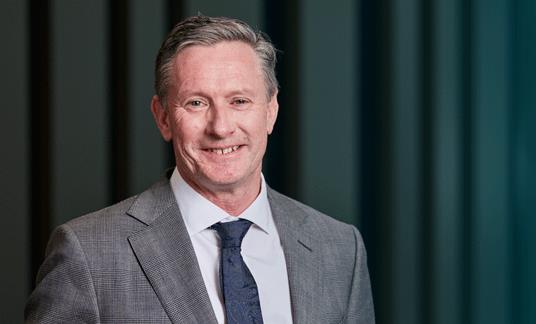
At ASPI’s Sydney Dialogue on 5 December, Director-General of National Intelligence Andrew Shearer reflected on major geopolitical trends. In a discussion with ASPI executive director Justin Bassi, Shearer said that ‘the biggest, most consequential change for Australia’ in the past few decades had been ‘the return of geopolitics,’ particularly the emergence of great power competition between US–China. At the same time, he remained generally optimistic, emphasising that history was not predetermined.
Shearer will become Australia’s ambassador to Japan in early 2026.
The following is a transcript of Shearer’s appearance at the Sydney Dialogue. Justin Bassi highlighted key takeaways from the discussion in an accompanying article.
Bassi: Looking back not just across the last five years, but really across your entire career—government, think tanks, policy departments, the intel community—could you take the room through the change that you’ve seen in particularly Australia’s with maybe the region’s strategic outlook? And indeed, do you actually see it as a change or more that we are actually just beginning to see what’s bubbling away for quite some time?
Shearer: I think I would start with an anecdote about my early career—showing my age here—but I started out my career about 35 years ago in the intelligence community. And not long after I joined what was then the Defence Signals Directorate, the Berlin Wall came down and that ushered in the collapse of the Soviet Union, Warsaw Pact, the end of the Cold War and what president George Herbert Walker Bush declared to be the new world order.
And with that, of course, came … decades of relative global stability, an end to the Cold War, of course, and the start of what we now call the era of globalisation. That was a very beneficial period for the world, for our region in particular, which was really the epicentre of global growth during that period and, in particular, for Australia.
I think we all know and feel that, even if we don’t follow international developments particularly closely, but that world is now gone, I would argue, and we’re in not a new world order but a new period of global disorder as that dispensation gives way to another one.
There are changes in the global climate system, in global energy, in global food security. There are deep changes in the global economy, in demography, globally. These are huge drivers, structural drivers of strategic change. And, of course, superimposed on that, we now have waves of disruptive technology sweeping through and transforming our economies and the way our societies function and the way we live as individuals.
But I think the biggest, most consequential change for Australia is the return of geopolitics and, in particular, the contest, the deep struggle between China and the United States for primacy, and that really is transforming Australia’s strategic environment and the environment within which as a country we have to seek our security, in future, and we have to seek our future prosperity.
So when I talk about this and, if you like, put together a word map to try to articulate to people what’s going on, the sorts of words that that throws up are ‘fragmentation’, ‘disruption’, ‘contestation’, ‘acceleration’.
Again, I think we all feel those forces at work around us, as we live our lives, and if you work in the national security field, you certainly feel those challenges acutely. And they’ve brought our workers in the intelligence community in Australia and our intelligence partnerships right into the centre of much that government does—framing these threats and challenges for government and also increasingly for a broader range of actors. Because many of these threats and challenges require not just a whole-of-government response but a whole-of-nation response.
Bassi: Do you think that in the current period of disorder that we [Australia] can be the ones to help reshape? Do you think that it is a matter of looking and just being voyeurs as the US and China take each other on, or can we help reshape the current disorder?
Shearer: Notwithstanding the somewhat sober appreciation that I’ve shared about what’s happening in Australia’s strategic environment, I remain an optimist. And, going to your question, there are some deep structural forces at play, which I have tried to outline.
But that doesn’t mean that our history or the world’s history is predetermined, notwithstanding that President Xi and President Putin, in this sort of Marxist-Leninist way, do believe that the forces of history are inevitably moving to their advantage and to our disadvantage. Because history teaches us that outcomes are a result of the interaction of structure but also agency, and Australia remains a country with many strategic advantages.
Our geography is a huge plus for us. We don’t enjoy the strategic depth we did for the last couple of centuries because modern weapon systems, including cyber, are radically reducing the geographical benefits of distance. But we still occupy critical geostrategic terrain at the hinge of the Indo-Pacific region, which makes us an important partner for many countries across the region.
We have natural resources. We have energy. We have food. We have a well-educated, well-informed, outward-looking population. We have strong institutions, notwithstanding some of the strains on our social cohesion we’ve experienced in recent years.
And critically, we have alliances and partnerships. Our most important strategic ally is the world’s leading power. It’s not just the world’s leading military power but, relevant to this conference, it’s by far the world’s leading technological power, even though that is obviously being challenged. We have the Five Eyes partnership, which is, of course, at the heart of our intelligence communities’ efforts, and we have new partners, including Japan. And I’m here [in Tokyo] in my capacity as director general of intelligence talking to key Japanese political leaders and officials about how we can strengthen our intelligence relationship with Japan. That will be increasingly vital, as will our wider defence and security partnership with Japan, which is already making major advances, like the Mogami frigate program.
We are close partners with India. We’ve got close partnerships with a range of key Southeast Asian countries. We’re working very hard with our counterpart agencies right across the South Pacific to strengthen their capacity and their resilience and their sovereignty. And we’re not neglecting the fact that geopolitics is global and we’re spending increasing time building up our partnerships with European countries—consistent with Australia’s contributions to supporting Ukraine in its war with Russia—because we recognise that developments in Europe can flow directly and quite immediately onto the Indo-Pacific.
So I think we’re a fortunate country. I think in any respects our future is in our own hands. We do have agency to work with our allies and partners to shape our region.
To use the phrase of the late Japanese prime minister Shinzo Abe, a free and open Indo-Pacific is vitally in Australia’s interests. I believe it’s in the interests of a wide range of regional countries, and we have an opportunity to work with our partners to shape our region around us.
Bassi: You mentioned tech and the lead that the Americans have had, particularly in terms of innovation and commercialisation over a number of years. History does suggest that having that lead in critical technology confers strategic advantage. So do you see it being the case that, given our history with technology, whoever develops and integrates the next evolutions, revolutions in technology, including AI, most successfully will either continue to be or become the most dominant global power?
Shearer: The geopolitical struggle that I alluded to earlier involves all the domains of national power, diplomatic, economic, military, paramilitary, ideational, I would argue. But technology really is the centre of gravity, increasingly, in that struggle. And that’s, I think, largely for the reason that technology generates power across all of those other domains. Therefore, I think the sharpest point of the struggle in some respects is around advanced technology.
We’re seeing it in the weaponisation of supply chains, including, most recently, rare-earth magnets, but also other critical minerals, the contest to control supply chains for advanced semiconductors. And, yes, clearly, both China and the United States see AI not just as a technology but, in a sense, as a critical enabler of national power, and both are wrestling for first-mover advantage in artificial intelligence. the United States brings enormous strengths—vast computing power, the world’s leading human brains on artificial intelligence, all of the creative potential and capacity, Silicon Valley, which in many respects gets about innovating impervious to government policy or direction from Washington—versus China, with its vast resources, its centrally directed model of state investments, and so forth.
I see that struggle as sharpening and I think the ebb and flow of that struggle will in many ways dictate how much power both of those countries have in future across all those dimensions of national power.
Bassi: If we have a look at some of the major developments in the Cold War that helped the US and its allies win, it really was won by looking across all of that national power, the full democratic power of states, working with industry and their civil society. And, with a few exceptions, industry and civil society also saw the need to defend their particular nation.
Do you think there is a risk now, while China and Russia have fused all their sectors, that in democracies, we may have actually seen a reverse—that there’s been a form of global commercialisation in which the companies and universities and other stakeholders are now not so much putting the nation first, [instead] putting the commercialisation first? Or are you a bit more positive than that?
Shearer: Again, perhaps defying stereotypes, I’m inclined to be a little more positive. I’d make a couple of observations:
The first one is, if you go back to that period I described at the start of my career, the key sources and drivers of technological change then resided within government. Most of the advanced technologies that swept through the world, including the internet, for example, came out of government, often the defence industrial base of the United States.
And our critical infrastructure was very largely owned and controlled by government. Again, I’m showing my age, but even our banks, our power companies, our telecommunications companies, our airlines were all essentially government owned, government controlled. And therefore, to the extent that there were issues between our security interests and our economic interests, there was a sort of coherence in the ability to respond.
That world is long gone, of course. And now, technology and many, many other aspects that bear on our national security are actually generated, owned by, delivered by the private sector. And that implies a complete transformation in how we think about not our future economic prosperity but our future security.
Where I’m a little more optimistic than your question implied is that I’ve spent a lot of time over the last five years in boardrooms across Australia, talking to directors, talking to CEOs of some of our largest companies. And what’s interesting about those exchanges is the way that we, as an intelligence community, can learn deeply from our corporate leaders about what’s happening out there in their world, their supply chains, in their markets, in their businesses, their perceptions of what the threats and risks and challenges are as we go forward into this uncertain future.
But we can provide valuable context for them. I think what I noticed after the Covid pandemic and then even more so after Putin’s invasion of Ukraine was that suddenly our business leaders wanted to hear about what was happening in geopolitics and how that might manifest for their businesses, for their supply chains, for future growth in their markets, and where their markets were.
A complete transformation in my view. And when we provide high-level context for them—about what’s happening in the world, the drivers of change, where we see the key threats—we can have a much richer, much more detailed and, frankly, much more trusting conversation about how some of our major businesses fit in, not only to Australia’s future prosperity, but to our security. And that’s providers of critical infrastructure, obviously, but it extends well beyond that.
Now what I find when I have those engagements is that our business leaders are tracking events, globally. There’s a demand for our insights into the trends, the threats and challenges we see. And overwhelmingly—and I don’t find this particularly surprising—our business leaders are patriots and they do care about Australia’s national interests. And I think many people who are there [at the conference in Sydney] might be a little bit surprised at how deeply we are partnering with industry in Australia, in terms of protection of our critical infrastructure, in particular, in our systems, but also increasingly in our region globally to Australia’s advantage.
It’s very much in two-way street. If you look at, for example, the importance of a number of Australia’s leading natural-resources and energy companies, they are globally significant players. And if you want to understand what’s happening in world energy markets or world markets for iron ore or for critical minerals, for example—as an intelligence community, we don’t have access to the granular detailed information and deep understanding of those markets that our industry leaders do. And that information for us is very valuable, and we weave that into our integrated intelligence assessments that inform government and also help us to inform our international partners.
So I think that that engagement is deeply two-way.
I think, five years ago, it might have been me approaching a CEO to suggest it might be time for an update for their board on issues. But I can tell you that increasingly CEOs from our big banks or other large Australian companies get in contact with me and say, ‘I’m having a board meeting. I’d like you to come and update us on what you’re seeing in Australia’s strategic environment.’
Bassi: In Estimates [a Senate committee hearing on 1 December] you said, ‘The guardrails that for decades separated competition from confrontation and conflict are weakening.’ Do you have any concern about our ability to continue managing competition or are you comfortable about that? Or do you think that we may actually getting close to the point where a transition from competition into conflict is inevitable?
Shearer: I can perhaps unpack a little of what I was driving at in Estimates, in answer to that question. What I was driving at is a troubling trend globally, and I would put Putin’s invasion of Ukraine high up this list … I’d take these events back earlier to perhaps around 2004 and that period through to the Global Financial Crisis, when I think if we had paid more attention to various pronouncements coming out of Moscow and Beijing, in particular, we would have taken a little more seriously some of the trends and the risks and the threats that are now manifesting.
I think, had we done so, we may have been a little more proactive in a whole range of areas, including expanding our defence industrial base, making sure our alliances were in strong shape and that we were building in more resilience.
The Russian invasion of the Ukraine, of course, broke through that sense of complacency across much of the West, and I think it made the nature of this emerging period more apparent to everyone—as I was saying, including our business leaders but certainly governments.
I’m troubled by the lowering threshold for conflict, by which I mean that Putin did not feel deterred from invading Ukraine, even after the United States released intelligence that was prescient about his intention to invade Ukraine and to invade it at scale.
We’ve seen a troubling proliferation of conventional conflict—thankfully, only conventional conflict thus far—not only in Ukraine, in the Middle East, obviously, including the 12-day war between Israel and Iran. We saw a relatively brief but dangerous clash between India and Pakistan, both, of course, nuclear-armed countries.
We’ve seen a border war between Cambodia and Thailand, and we’ve seen a troubling increase of paramilitary activity through much of the Indo-Pacific, dangerous interceptions involving Australian and allied ships and aircraft.
All of this, I think, points to the fact that we’re going to have to work harder to shore up the military balance, we’re going to have to work harder to respond to these grey-zone challenges, right across our region, and ultimately we are moving into an era where deterrence is becoming more important. And as the military balance between China and the United States shifts away from the United States and its allies, maintaining deterrence is becoming more challenging. That’s a reality.
But it doesn’t mean it’s impossible to maintain deterrence. It means we have to work harder. It means we have to work with a greater sense of urgency. It means we have to strengthen our existing alliances but also build new strategic partnerships.
But again, ultimately, I believe that we can uphold deterrence and navigate this very difficult and dangerous five- to 10-year window.
Bassi: Do you think that part of the issue, part of the struggle for democracies is that we may have lost a bit of faith in ourselves? It’s one thing to know what Russia and China are doing, but to actually maintain deterrence we actually have to have them feel or perceive that we feel we will win if they did anything, and that part of the problem is that part of their strength is perhaps the feeling that we are down on confidence.
Shearer: I do not believe that the United States or the West are in terminal decline, although I do ruefully acknowledge that we give on occasion, a reasonable impression that we might be.
I think there’s no doubt that our societies are being affected by economic challenges, especially around standards of living, the cost of living, pressures on productivity, aging societies, growing demands for aged care and other forms of social support.
There’s no doubt that these societies are dealing with a range of very serious and substantial challenges. I also acknowledge that our competitors are ruthless, purposeful, well-resourced, moving with purpose and self-belief. But I totally reject the notion that even though they are working more closely through the axis of authoritarians or the CRINKS, or whatever label you want to give to that phenomenon. I still believe deeply in the fundamental strengths of our systems, our political institutions, or societies, and that ultimately freedom is a preferable model.
Advanced repressive technologies of different types, the ability to marshal resources, to coordinate strategy, perhaps more effectively than democracies, all of these are advantageous, in some circumstances, to our adversaries. But they are not 10 feet tall. They have problems, the extent of corruption across China, the glaring absence of about 20 percent of senior leaders of the Chinese Communist Party at the recent plenum, continuing corruption in the PLA, Russian casualties—appalling Russian casualties—in the war on Ukraine, the medium- and long-term damage that’s been done to the Russian economy by running what is now a pretty well-functioning war economy.
They are storing up massive problems for the future. And the idea that a centrally directed, repressive model is going to be more sustainable over time than our open, free systems, I reject. There are two things that are paralysing. One of them is fear and fatalism. So in other words, the feeling that from time to time perhaps we all have, that our adversaries are formidable and making gains, that can put us in a complete funk and can lead people to throw up their hands and say, well, it’s not even worth competing and why would we support this issue? Or why would we support that country? Or why would we care about that particular island? That is paralysing and that robs us of our agency, and ultimately it robs us of our sovereignty.
But complacency is equally paralysing. I think for Australia, the key, and we can do this and we have done it in the past, the key is to bring a clear realism to the challenges we face and a clear realism to the strengths and advantages we have as a country, which I tried to outline earlier. And finding that mature, realistic position that reflects our strengths as a country is how we exercise our agency, and it’s ultimately how we uphold our sovereignty.
And right at the heart of that is the realisation that our alliance with the United States doesn’t reduce our sovereignty in our decision-making space; it increases it. So does AUKUS. So does the Quad. So do all these partnerships that we’re working to build, and so does building up our national resilience, our cyber security, our economic security and our national security.

