
With risks to the economy rising, central bank ready to respond if outlook changes
Article content
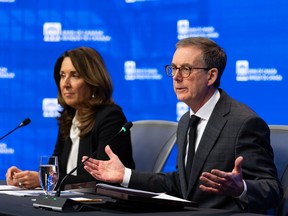
The Bank of Canada is grappling with how to weigh the unprecedented set of risks facing its outlook for the Canadian economy, according to the statement of deliberations explaining its Jan. 28 decision to hold the key overnight interest rate at 2.25 per cent.
Article content
In the deliberations, released on Wednesday, the central bank’s governing council said it faced challenges when trying to assess relative importance of geopolitical turbulence, the review of the Canada-United States-Mexico Agreement (CUSMA) and risks related to the economy’s adjustment to trade disruptions.
Article content
Article content
Story continues below
Article content
“With uncertainty heightened, the range of possible outcomes that could materially change the outlook had broadened,” the governing council, led by Bank of Canada governor Tiff Macklem, wrote.
Article content

Top Stories
Article content
“Moreover, in the context of an unpredictable environment with little historical precedent, it was unusually difficult to effectively assign weights and probabilities to the various risks surrounding the outlook.”
Article content
The central bank has said it will maintain interest rates so long as the economy grows in line with its anticipated outlook.
Article content
Governing council concluded that the risks around its outlook had moved higher and though economic growth over the next couple of years was still largely in line with what has been expected since last fall, central bankers would have to be prepared to respond if the outlook changes.
Article content
“Geopolitical tensions and U.S. trade policy remained unpredictable, and uncertainty about how the Canadian economy would adjust remained elevated,” the document said. “Against this backdrop, members agreed that they would need to maintain optionality in setting monetary policy.”
Article content
Story continues below
Article content
Among the challenges the Bank of Canada faced in its deliberations was that trade and geopolitics have become intertwined, which makes it difficult to assess the impact on key economic drivers such as inflation.
Article content
Read More
-

Business leaders’ outlook slightly sunnier than its Bank of Canada’s
-

Macklem says loss of CUSMA would mean recession
-
Advertisement 1
Story continues below
Article content
“U.S. trade policy, increasingly used for geopolitical aims rather than economic ones, had become more unpredictable,” the governing council wrote. “Escalating tensions could lead to disruptions in global supply chains and could weigh on economic activity, posing both upside and downside risks to inflation.”
Article content
Despite the uncertainty for the future, the Bank of Canada’s outlook remained largely in line with what the central bank has been expecting since last fall. Gross Domestic Product is expected to grow modestly, by 1.1 per cent in 2026 and 1.5 per cent in 2027, reflecting continued effects of trade disruptions, uncertainty and slower population growth.
Article content
Inflation, meanwhile, averaged 2.1 per cent in 2025 and has been within the one per cent to three per cent band for two years, in line with the central bank’s target rate.
Article content
“Still, (governing council) members acknowledged that food price inflation and rent inflation were areas of concern for Canadians struggling with the cost of living,” the statement of deliberations said. “Short-term consumer inflation expectations remained somewhat elevated, even as longer-term expectations had softened.”
Article content
• Email: bshecter@postmedia.com
Article content

