
ALMATY – Geopolitics is no longer an abstract field reserved for governments and military strategists as it has become a practical necessity for businesses navigating sanctions, supply chain disruptions and a rapidly shifting global order, experts said during a Feb. 2 session at Narxoz University.
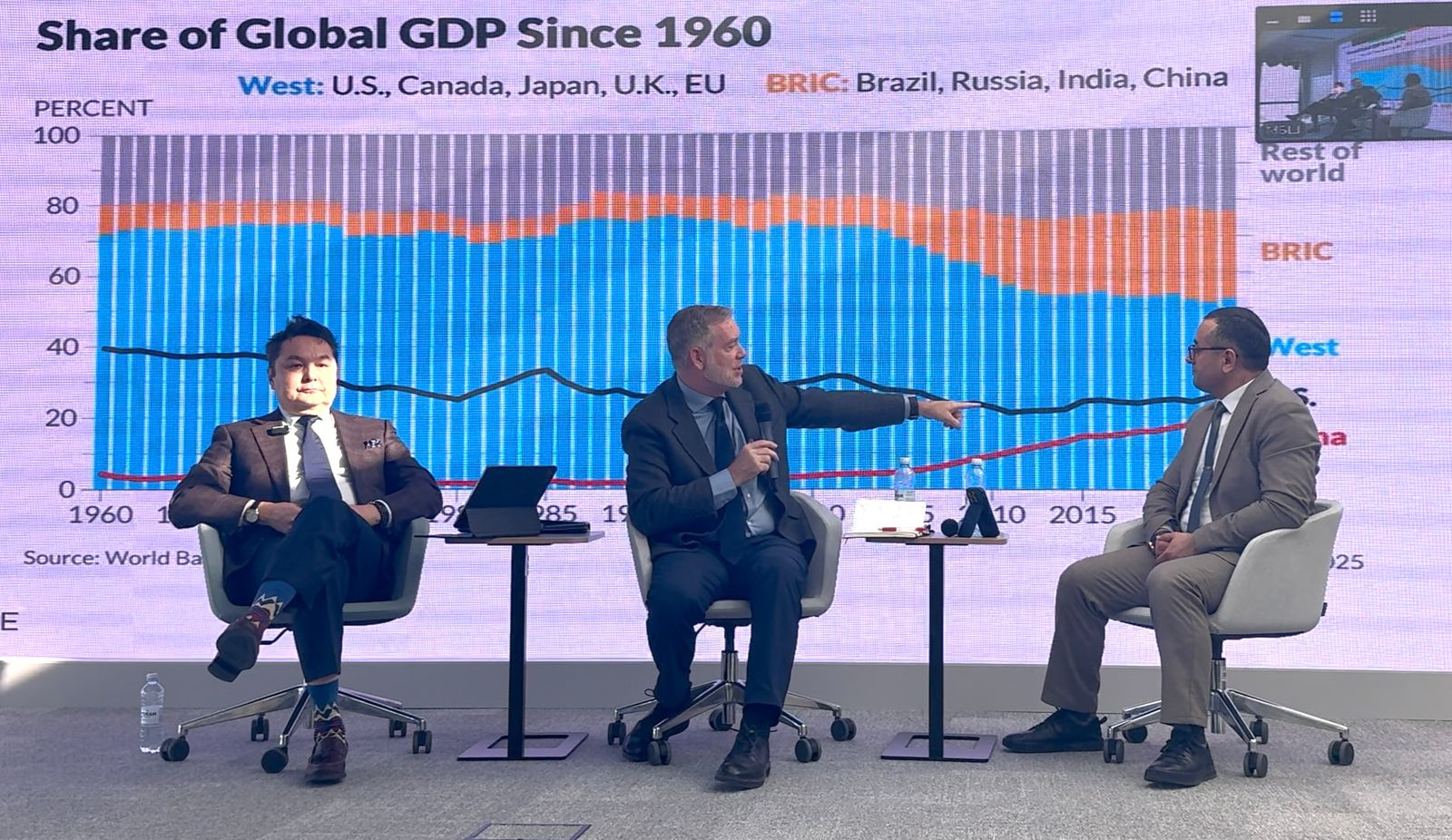
Rodger Baker, executive director and founder of Stratfor Center of Applied Geopolitics at RANE, echoed the view that geopolitics is becoming a core business concern rather than a purely state-centered discipline. Photo credit: The Astana Times.
Addressing the audience, Executive Director of HeartLand Expert and Analytical Center Emin Jabbarov stressed that discussions of geopolitics often remain detached from real economic activity in Kazakhstan.
“Why is geopolitics important for business? Because in Kazakhstan, especially in the Kazakh context, when we talk about geopolitics, politics, international relations, or security, it often turns into a very egocentric, snobbish, fancy party, where political analysts discuss strategies, scenarios, forecasting and foresight,” he said, noting that such conversations rarely translate into practical guidance for decision-makers in the private sector.
Geopolitics and business decisions
Jabbarov stressed that globalization and the free movement of capital have made geopolitical awareness essential for companies, not just states.
“An understanding of geopolitics, even its basic principles, is essential for businesses and decision-makers. Nowadays, governments are smaller, and businesses are bigger. Companies influence decisions, shape societies and have a real impact,” he said.
He pointed out that businesses increasingly face challenges once considered purely political, including international sanctions. Jabbarov also highlighted emerging concepts such as the Middle Corridor, questioning how well businesses truly understand these evolving geopolitical frameworks.
Forecasting in an uncertain world
Rodger Baker, executive director and founder of the Stratfor Center of Applied Geopolitics at RANE, echoed the view that geopolitics is becoming a core business concern rather than a purely state-centered discipline.
“Geopolitics as a field has traditionally been something that is used by governments and militaries for thinking about national-level strategy. Geopolitics helps companies sort of think about where they are in the world, what are their risks, what are their opportunities,” Baker said.
He emphasized that today virtually every company is connected to global supply chains.
“No company is any longer an international company. Everybody is connected to supply chains somewhere,” Baker said, adding that even firms that see themselves as domestic rely on international flows of materials, technology and markets.
A more fragmented trade environment
Baker described the current global system as increasingly multipolar, with regional dynamics playing a greater role and trade arrangements becoming shorter-term and more volatile. According to him, this environment requires businesses to monitor not just markets but also political and regulatory shifts that can quickly alter costs and logistics.
Baker emphasized that what is often labeled geopolitical risk actually manifests through familiar business risks such as supply chain disruption, regulatory changes and transport delays.
“Geopolitics provides you with a way to look at risk holistically. To look at all of the different avenues of risk,” he said.
He cited tariffs, conflicts and bottlenecks in critical mineral processing as examples of geopolitical factors reshaping corporate strategies, particularly in high-tech sectors such as artificial intelligence.
“The battleground today is the AI battleground, right? Who’s going to dominate AI? Who gets chips? Who doesn’t get chips? Where do they come from?” Baker said.
Building geopolitical awareness inside companies
One of the biggest challenges, according to Baker, is organizational, as many firms lack a clear structure for analyzing geopolitical developments.
“What we’re not seeing in most companies is a unified approach to understand how this impacts each slice and how those slices in the company interact with each other,” he said.
He encouraged businesses to assess their supply chains beyond direct partners and to map potential vulnerabilities against global risk trends. Rather than relying on simple worst-case planning, companies should develop multiple plausible geopolitical scenarios.
“If you’re trying to lay out geopolitical scenarios to understand the structure of the world, you need to start building plausible future scenarios, not best and worst cases, because those don’t help you,” Baker said.
Get The Astana Times stories sent directly to you! Sign up via the website or subscribe to our X, Facebook, Instagram, Telegram, YouTube and Tiktok!

