
When news of the fragile ceasefire between the United States, Israel and Iran first broke, it came via a post on X by Pakistan’s Prime Minister, Shehbaz Sharif.
Securing such a big diplomatic win is highly significant for Pakistan, irrespective of how the agreement has since been tested.
Pakistan will remain central to ongoing peace negotiations, with talks between the parties being held in the country on April 10.
So how did Pakistan manage to bring the parties together? It harnessed long-running relationships, shared histories and security agreements to flex its diplomatic muscles.
Pakistan and Iran go back a long way
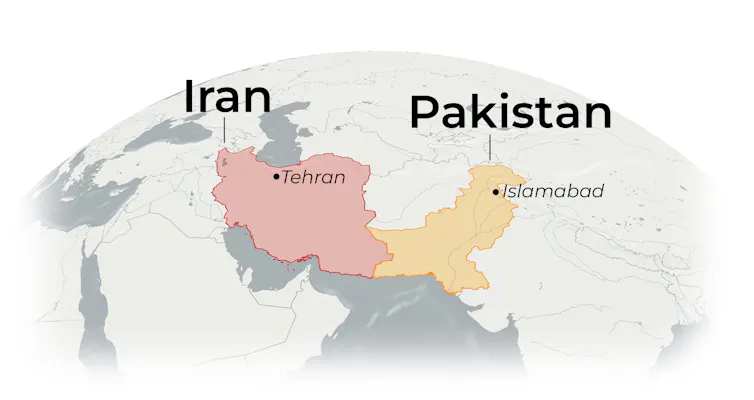
Pakistan and Iran have a long history as friends and allies. Sharing more than 900 kilometres of border, the countries have been involved in dispute mediation for one another since Pakistan’s creation in 1947.
During Iran’s monarchical period, which ended in 1979, Pakistan relied on Iran’s mediation in its disputes with Afghanistan, and active support in Pakistan’s wars with India in 1965 and 1971.
But the relationship has not been free of challenges. Pakistan’s Prime Minister Z A Bhutto, according to some sources on the ground, resented the Iranian Shah’s overbearing attitude.
The closeness has held since the Islamic regime took over. With nearly 20% of Pakistan’s population being comprised of Shia Muslims, the dominant form of Islam in Iran, there’s long been a close relationship between those Pakistani Muslims and the Iranian regime.
Iran has used these communities to spread their version of Islam and politics, but it has walked a fine line. The regime has ensured tensions do not exceed beyond certain point where the Pakistani government considers it to be a destabilising factor and a threat to Pakistan’s security.
Because of this shared history and the geographic proximity, the Iranian regime is at least willing to listen to Pakistan.
Eyeing regional and national security
This is particularly so because of Pakistan’s own security situation, especially in the event that a weakened or fragmented Iran would result in the emergence of multiple smaller states.
Pakistan’s geographically largest province, Balochistan, has been experiencing renewed militancy spearheaded by separatist group the Baloch Liberation Army. The militants have attacked multiple military targets, law enforcement agencies and public servants, especially those hailing from the Punjab province (the largest in terms of population and resources).
There has been a growing sense in Pakistan that a weakened or fragmented Iran could further strengthen the appeal of Baloch Liberation Army ideology. The Pakistani government doesn’t want a situation where calls for a greater Balochistan encompass areas on both sides of its border with Iran.
Another consideration is that Pakistan has a nuclear program. The Pakistani government may fear its nuclear arsenal being next in line for targeting by foreign countries, and therefore seek to de-escalate tensions across the region.
It’s also worth noting the potentially precarious position Pakistan finds itself in geographically. The spectre of being sandwiched between an Israeli-controlled Iran, and close Israel ally India, would be something to be avoided.
It’s likely the Iranian regime is aware of these concerns and appreciates that Pakistan’s mediation is grounded in the latter’s own security concerns. But from an Iranian perspective, that’s hardly a bad thing: it means exploring all possible scenarios to reach a ceasefire and a settlement.
Friends in MAGA places
Pakistan is highly credible with the Trump regime. This is primarily because of the dominant role the Pakistani military has played in shaping the country’s foreign policy. This influence has existed for almost 80 years, but has ramped up recently.
In 2022, General Asim Munir took over as the Chief of Army Staff. He was promoted to the rank of Field Marshal in the wake of Pakistan-Indian “mini-war” in May 2025.
Currently occupying the position of Chief of Defence Forces with a guaranteed command of the military for the next five years with the possibility of extension until 2035, he has emerged as the strongest army general to have ruled Pakistan in decades.
Munir has established a cordial relationship with US President Donald Trump. He visited the administration twice, including a meeting in the Oval Office. This was before Australian Prime Minister Anthony Albanese had secured even a telephone phone call with the president.

Andrew Harnick/Getty
Munir has also guided Pakistan’s Gulf policy, particularly the signing of a Strategic Mutual Defence Agreement with Saudi Arabia in September 2025. The agreement builds on the decades of a defence relationship between Pakistan and Saudi Arabia. It includes the clear articulation that any attack on one is considered an attack on both.
Though Pakistan is careful to stress that it does not extend a nuclear umbrella to Saudi Arabia, the agreement signals regional deterrence and ability of the two states collaborating against opponents.
The agreement was followed by a Strategic Defense Agreement between Saudi Arabia and the US during the Crown Prince Mohammed bin Salman’s visit to Washington in November 2025.
Effectively, therefore, a tripartite quasi alliance has emerged between the US, Saudi Arabia and Pakistan.
And then there’s China
At the same time, Pakistan also maintains strong military, economic, and political relations with China. Beijing has been keen to de-escalate the situation in the Gulf due to China’s reliance on oil supplies from the region.
This interest was categorically expressed during the visit by Pakistan’s Foreign Minister, Ishaq Dar, to China on March 31.
Coming soon after Pakistan’s quadrilateral meetings with Saudi, Egyptian and Turkish foreign ministers, the negotiations established Pakistan’s credentials as a state that has the backing of significant Muslim majority states. Combined with the support of China, Pakistan was in prime position to explore solutions to the conflict, without Trump losing face.

