
Italian Prime Minister Giorgia Meloni’s strategy appears to focus on keeping the US engaged while ensuring that EU powers like France and Germany do not become too dominant.
Kyiv Post speaks Elio Calcagno from the Istituto Affari Internazionali, who focuses on military strategy and technology, about Meloni and Italians’ often contradictory relationship with Ukraine.
JOIN US ON TELEGRAM
Follow our coverage of the war on the @Kyivpost_official.

Wojciech Albert Łobodziński: How does Giorgia Meloni maintain the stability of her coalition while managing the diverging views of partners like Matteo Salvini, whose past pro-Russian sentiments contrast with the current government line?
Elio Calcagno: In the history of Republican Italy, the priority of any government has been survival. Today, we are witnessing a level of stability rarely seen in our history. Meloni has shown a remarkable ability to keep the coalition together despite the vastly different views on matters of foreign policy with some of her coalition partners.
A key factor is that junior partners realize that if they collapse the government, they lose the opportunity to deliver on their political promises. Meloni performs a delicate balancing act, satisfying many of their requests on secondary issues while maintaining the government’s main strategic thread. Ukraine is a prime example. Despite Salvini’s long history of pro-Russian stances – symbolized by his Putin T-shirts and his public confrontation at the Polish border – Meloni has successfully managed this tension.
Other Topics of Interest
A Year of Trump: Different Logic and New Rules of the Game
A year after Donald Trump took office, Kyiv Post spoke with Filip Styczyński, founder of PATRIOT Alliance, about how the US is redefining the rules of a multipolar world.
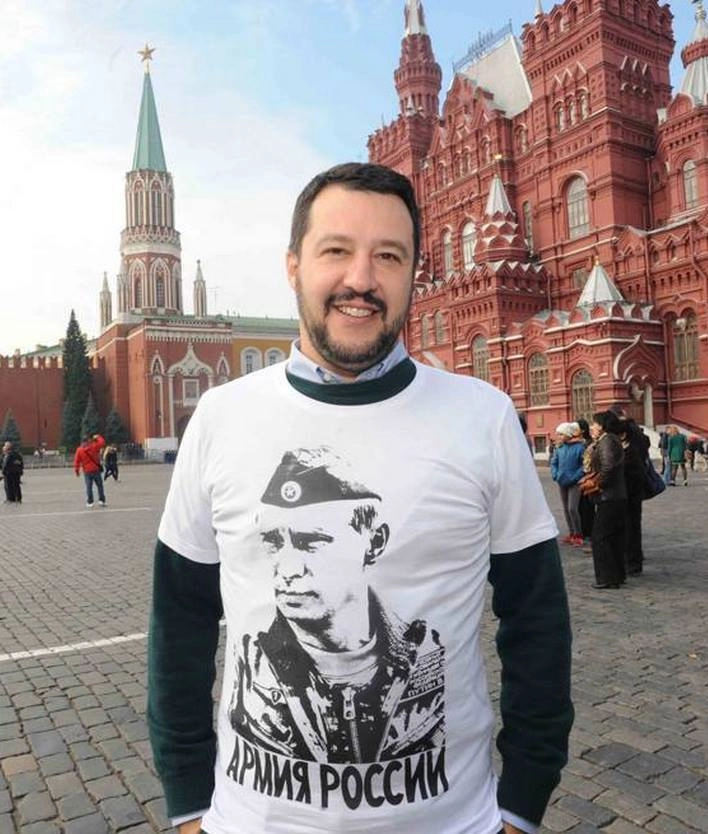
Matteo Salvini wearing a Russian Army T-shirt in Moscow, 2014, (Photo: Facebook page of Matteo Salvini)
Furthermore, there is a classic Italian political tactic at play: minor partners may publicly oppose a policy to satisfy their voters, yet their parliamentarians will still vote in favor of it. We see this with defense spending, where some parties opposed the now-obsolete 2% pledge they once supported and voted through while in power.
Finally, while Forza Italia carries Berlusconi’s legacy of complex ties to Russia, they have remained pragmatic under Antonio Tajani, who is also the foreign minister. Their language may be slightly less combative on Russia and Putin than that of the defense minister, who belongs to Meloni’s Brothers of Italy party, but their pragmatism allows Meloni to preserve a mostly unified front.
How can Meloni and her administration revive the Italian high-tech sector, specifically where it intersects with the military? Is public debt a primary obstacle to developing these capabilities?
Public debt is a factor in every sector requiring investment; interest payments consume a significant portion of our budget, limiting our ability to address problems where funding is essential.
However, Italy faces other structural challenges. While Italy is the second-largest manufacturing power in Europe, a fact often overlooked abroad and in Italy, small, family-run companies represent a large portion of its industry. These firms naturally struggle to invest significantly in new technologies and face higher credit costs, which hinders their competitiveness.
In the defense sector, the situation differs because it is dominated by two major players: Leonardo and Fincantieri. Both have performed exceptionally well since the full-scale invasion of Ukraine. However, as these giants typically acknowledge, true innovation frequently stems from startups and small-to-medium enterprises that take significant risks. Due to the general issues affecting Italian industry, this innovative side of the sector struggles. Consequently, we still rely heavily on foreign suppliers for high-tech solutions like artificial intelligence and high-performance computing.
This is also a broader European problem; we lack the massive tech companies capable of investing billions into research labs and data centers. Finally, the lack of public funding has caused our university research sector to lag for decades. Many Italian researchers move abroad for their PhDs and postdoctoral work. Since universities are increasingly crucial for research in the defense sector, this “brain drain” is a major hurdle. While the current government, like its predecessors, is attempting to address this, the lack of available capital remains a persistent barrier to progress.
Given his political importance, would you agree that Carlo Calenda is now the most steadfast supporter of Ukraine in Italy? How does his position influence the parliamentary debate on national security?
Located in the political center, Calenda has adopted a pragmatic approach, supporting the government when their goals align with his program. I agree he is currently the staunchest supporter of Ukraine. He has invested significant political capital into this fight, especially over the last six months.
His primary role has been challenging the anti-Ukraine and anti-Zelensky commentators who frequently appear in Italian media. These voices often repeat Kremlin propaganda, suggesting Ukraine provoked Russia or that NATO encirclement caused the conflict. This pro-Russian narrative, playing on elements of pacifism as well as anti-American and anti-EU sentiments already present in Italy, is a significant factor in shaping Italian public opinion, a complexity often missed by outside observers.
Calenda, alongside Defense Minister Guido Crosetto, is actively working to provide a counter-narrative to what is frequently a hostile or indifferent media landscape. By engaging in these public debates, Calenda is essentially conducting “counter-disinformation,” pushing back against dominant tropes to reshape the national security conversation.
Historically, Italy has tried to act as a bridge between Washington and Brussels.
Is Italy ready to continue providing financial and military assistance to Ukraine?
The Italian government has provided Ukraine with 12 so-called “military aid packages” since February 2022, and it is unlikely to end this policy of support as long as other European countries stay committed. The content of these packages is classified for political reasons, so there are no official figures as to how much the military equipment donated so far is worth.
However, Gen. Luciano Portolano, the defense chief, has recently claimed this figure is over €3 billion ($3.5 billion), though the government has not confirmed it.
Italy, like many European partners, has very little to spare in the way of advanced weaponry, but it has made a considerable effort nonetheless. For instance, Rome has donated at least three of its modern SAMP-T air defense systems, and these are the only weapon donations that the government has publicly acknowledged. Despite budgetary constraints, the need to reconstitute warfighting capabilities, and the government’s political balancing act, Italy can be expected to continue supporting Ukraine where it can.
If a future geopolitical shift forces a choice, will Meloni prioritize a strategic alignment with Trump or remain committed to the current pro-Ukraine European consensus?
This is a difficult question because Meloni, like many politicians, has evolved. Early in her career, she held more anti-NATO and anti-EU views regarding Ukraine after 2014. Yet in government, she has been staunchly pro-Ukrainian. Consequently, I cannot exclude further shifts in her positioning.
Historically, Italy has tried to act as a bridge between Washington and Brussels. Due to decades of political instability, our foreign policy often lacked internal legitimacy. It was easier for governments to tell constituents they were acting because the EU or NATO “asked us to,” rather than defining specific national security interests, which remain less bipartisan in Italy than elsewhere.
Meloni has been skillful at playing both camps.
Exactly. Her government recognizes that the US is drifting away from Europe; she downplays the problem without ignoring it. Her strategy appears to focus on keeping the US engaged while ensuring that EU powers like France and Germany do not become too dominant at the expense of Italian interests.
If forced to choose, it is hard to say for certain. However, Italy historically dislikes being isolated in Europe. Even if Meloni tries to keep the US engaged longer than others, Italy would likely eventually align with the European side. Ultimately, the preferred outcome for Meloni – and most Italian parties – is that such a choice never has to be made. Our foreign policy has long relied on playing in both fields to advance our own interests.

