
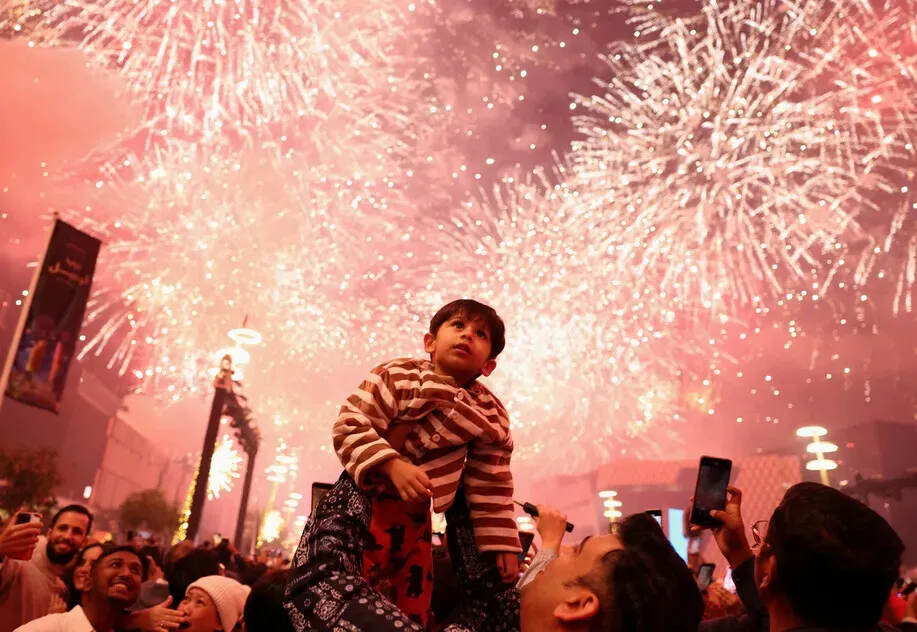
A child watches as fireworks light up the sky in celebration of New Year’s on Jan. 1, 2026, in Doha, Qatar. (Reuters/Yonhap)
In 2006, the International Crisis Group predicted in its annual report that sectarian politics would take hold in the Middle East, while the influence of regional powers like Iran and Syria would increase. It forecast that internal conflicts that border on civil war will extend into the long term in Nepal and Sri Lanka. It suggested that the US must get involved in resolving long-term international conflicts rather than focusing on military intervention.
The report concluded that predictions that after the Cold War, the global order would automatically stabilize and produce peace through the global market were wrong, and that civil wars in vulnerable countries would calcify into permanent conflicts. However, the report only pointed the finger at instability in the Middle East; it did not call out the brutality of Israel, which is conducting a brutal genocide that is starving Palestinians to death.
The same year, the German Institute for International and Security Affairs issued a report titled “China’s Rise: The Return of Geopolitics?” The question in the title struck a major chord by clarifying that China’s rise is not a simple matter of economic growth. The report identified it as a development that would change the nature of the international order. However, the report did not predict that the US and China would fight through economic protectionism, dividing the world into different factions.
Compared to the world that international think tanks envisioned 20 years ago, today’s reality is much starker. After surviving the era of America’s war on terror, the global financial crisis, and instability in the Middle East, why does our current era feel so much darker? Maybe it’s simply a factor of time — that the gravity of what’s in the rear-view mirror has seemed to fade, while our own present moment feels gloomier than ever.
The future envisioned by the aforementioned reports, the World Economic Outlook report from the International Monetary Fund, reports on international security submitted to the UN, and the Stern Review on the Economics of Climate Change commissioned by the UK government in 2006 goes as follows: The US’ strength will weaken while China, India and Russia will rise — but not to the point of challenging the world order. Everybody will converge and unite under the system as China increasingly falls in line under the international order. Countries that develop economically will see exploding middle classes, who will bring about political change.
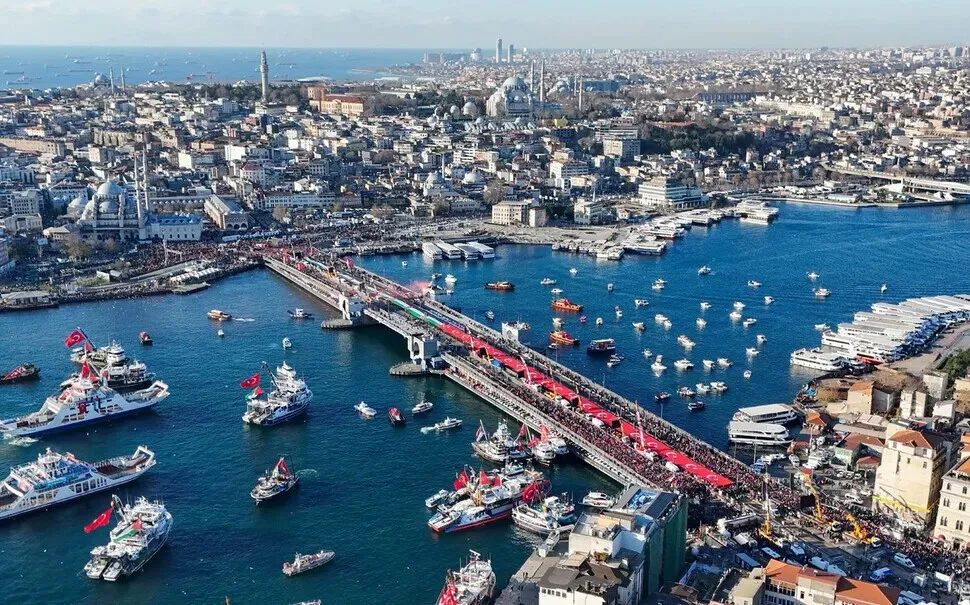
On Jan. 1, 2026, thousands marched through Istanbul, Turkey, to show solidarity with Palestine. (Xinhua/Yonhap)
The description of China in 2005 as a “responsible stakeholder” by then US Deputy Secretary of State Robert Zoellick is a primary example of this outlook. The view that globalization would not wane was another trait of idealists during that era. People viewed the global convergence of financial markets as inevitable and irreversible. The global supply chain would become more complex, and once countries became mutually reliant, key players would focus on cooperation more than competition.
While climate change was warned of as an imminent crisis, it was viewed as something we could gradually manage. The perception of climate change being directly linked to geopolitical conflict and national security was minimal. However, the genocide and massacres in Darfur, Sudan, East Africa, and the Syrian civil war were exacerbated by droughts induced by climate change. In 2021, the island nation of Madagascar was described as experiencing the first drought caused by climate change in history.
Views on technology 20 years ago were also optimistic. People thought that information technology would expand while developments in bioengineering, nanotechnology, and green energy would create an explosion of new opportunities. Nobody thought that the chip supply chain would lead to a conflict between the US and China. AI was not brought up as a major factor in international relations.
What made the world a darker place? Rather than the predictions being wrong, the basic presumptions regarding the “way the world works” of the people who made such predictions were off base. The 2008 financial crisis shook the foundations of the economic system. At the time, the IMF described it as the “largest financial shock since the Great Depression.” Political and social divides, wealth disparities, and polarization worsened through the crisis. Populist politicians and the far right emerged more powerful. What about the pandemic?
The SARS (severe acute respiratory syndrome) outbreak in 2002 was a warning sign, but the scale of the COVID-19 contagion was unexpected. Ultimately, it’s a series of crises that have made the present worse than people expected. A financial crisis, civil wars, a pandemic, and geopolitical shocks occurred as if in a delayed chain reaction.
Almost none of the analysts in the past expected a full-scale war in the form of Russia invading Ukraine.
What does the future hold?
NATO’s “Science and Technology Trends 2025-2045” report predicts that new technologies like AI and quantitative computing will become key factors in national security. KPMG Consulting published a report on the top geopolitical risks in March 2025, discussing strategic rivalry between the US and China, blocs forming around regional powers, protectionist trade policies, and the politicization of supply chains. The International Energy Agency declared that if current trends continue, the amount of fossil fuels we consume will continue increasing until around 2040-2050.
It’s only a matter of time before China’s economic scale surpasses that of the US, and India’s economy grew larger than Japan’s last year, authorities have announced. Changes in economic strength will ultimately shake the international order, and people now talk about the possibility of a “clash of giants” between superpowers.
Will the world become even darker over the next 20 years? Over the past 20 years, the average global lifespan has increased by six to seven years, while the mortality rate among children under the age of 5 has fallen by over 50%.
Increased vaccination in Sub-Saharan Africa has been effective. AIDS is now a chronic condition that is not fatal but manageable. Over 90% of the world receives an elementary education. Aside from the US, every country in the entire world has agreed to reduce carbon emissions. The costs of solar and wind energy have decreased by 70% to 90% since 2010.
Liberia in West Africa, Colombia, and several other places have stabilized.
While predicting the future is pointless and bound to go wrong, we can still hope, can’t we? I, for one, am starting my new year imagining a world for the children of Gaza, the people of islands sinking into the ocean, the Syrians who have emerged from civil war, and people around the world who are sick of polarization.
By Koo Jeong-eun, freelance international affairs reporter
Please direct questions or comments to [english@hani.co.kr]

