
Washington’s total boycott of the leaders’ summit marks the first time any member state has absented itself from a G20 summit.
New Delhi: Despite the United States staying away from the summit, leaders of the world’s major economies adopted a declaration at the opening of their two-day gathering in Johannesburg that notably steered clear of strong language on ongoing geopolitical conflicts.
In his opening address at the G20’s first summit in an African nation on Saturday (November 22), chair South Africa’s President Cyril Ramaphosa invoked Pliny the Elder’s dictum “always something new out of Africa” and called for a show of hands to adopt the outcome document.
The declaration was adopted without objection by all members except the absent US.
In a pointed message to Washington, Ramaphosa said that there was “overwhelming consensus” among heads of state that one of the first tasks of the summit should be to adopt a declaration. “We should not allow anything to diminish the value, the stature and the impact of the first African G20 presidency,” he said.
The Trump administration’s total boycott of the leaders’ summit marks the first time any member state has absented itself from a G20 summit since the grouping’s formation in 1999 following the Asian financial crisis.
Washington based its absence on false claims by US President Donald Trump that White Afrikaners are being “slaughtered” in South Africa.
US absence triggers unprecedented break in G20 tradition
Ahead of the summit, the US warned that the absence of any American officials should prevent the adoption of a declaration, signalling this position to other member states.
“It is a long-standing G20 tradition to issue only consensus deliverables, and it is shameful that the South African government is now trying to depart from this standard practice despite our repeated objections,” a senior White House official said on Friday.
A day later, South African foreign minister Ronald Lamola pushed back on state broadcaster SABC, stating that the multilateral platform “cannot be paralysed on the basis of the absence of someone who was invited”. He added: “This G20 is not about the US. It is about all 21 members of the G20. We are all equal members. What it means is that we need to take a decision.”
The South African president’s spokesperson Vincent Magwenya told reporters that the declaration, which contains language the US opposes, “can’t be renegotiated”.
The boycott has complicated protocol surrounding the formal handover of the G20 presidency, which passes to the US next year. Washington proposed that the South African president hand the presidency over to the local US embassy’s chargé d’affaires at the summit’s close on Sunday, but South Africa rejected this as a breach of protocol.
Instead, the US will have to “collect” the presidency from the South African foreign ministry in the coming days.
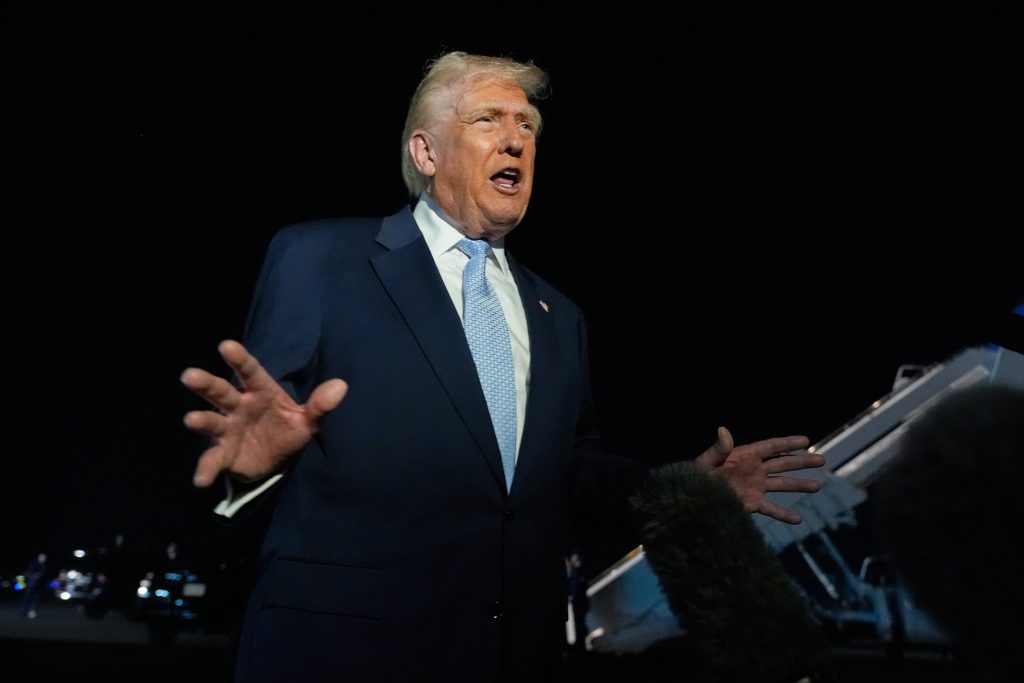
Washington based its absence on false claims by Trump that White Afrikaners are being “slaughtered” in South Africa. Photo: AP/PTI.
Shift from New Delhi and Rio as conflict language diluted
In recent years, G20 summits had been plagued by last-minute negotiations and uncertainty over joint declarations, starting with the one in Bali that was held the year Russia invaded Ukraine.
Two years ago in New Delhi, it had come as a surprise when India announced that consensus was reached on a G20 joint declaration after the group hashed out language on the Ukraine war on the first day itself.
That breakthrough came after a year of chair’s statements only, as Russia, China and the West remained at loggerheads over wording – a standoff that had effectively blocked any joint statements.
Last year in Brazil, similar apprehension clouded talks over the draft text, compounded by anxiety about Trump’s incoming administration. The final Rio declaration softened language on Ukraine, though Argentina dissented separately, with the Javier Milei government objecting to what it called the agenda’s “socialist nature”.
But while these previous declarations had faced white-knuckle negotiations over language on Ukraine or Gaza, this time, the Johannesburg declaration just barely skimmed over it.
Using general terms, the G20 leaders stated that their meeting was being held “against the backdrop of rising geopolitical and geo-economic competition and instability, heightened conflicts and wars, deepening inequality, increasing global economic uncertainty and fragmentation”.
With no reference to any particular war, they noted “with distress the immense human suffering and the adverse impact of wars and conflicts around the world”.
There were three paragraphs that focussed on the principles of the UN charter while also mentioning that the G20 nations “condemn all attacks against civilians and infrastructure”.
The only mention of specific conflicts was in a single sentence that talks of the need to achieve sustainable solutions.
“We concur that, guided by the Purposes and Principles of the UN Charter in its entirety, we will work for a just, comprehensive and lasting peace in Sudan, the Democratic Republic of Congo, the Occupied Palestinian Territory, Ukraine, as well as ending other conflicts and wars around the globe. Only with peace will we achieve sustainability and prosperity,” said the 2025 G20 declaration.
In contrast, the 2023 New Delhi declaration had seven paragraphs dedicated to the Ukraine war. The following year at Rio, there was one paragraph about the Ukraine war, which spoke of “recalling our discussions in New Delhi” to echo language about “human suffering” and the “negative” impacts on the global economy and food security.
European and Western leaders present in Johannesburg were meanwhile occupied with a series of sideline meetings on the fallout from the controversial peace plan proposed by Trump to end the Ukraine war, saying it would “require additional work”.
French President Emmanuel Macron cautioned that the G20 risks losing relevance if it cannot deliberate and find common ground on global conflicts. “The G20 may be coming to the end of a cycle,” he said. “We are living in a moment of geopolitics in which we are struggling to resolve major crises together around this table, including with members who are not present today.”
The 2024 declaration also included a longer paragraph on Gaza calling for a comprehensive ceasefire and the expansion of humanitarian assistance, and reaffirmed the two-state solution.
The absence of more robust language on Gaza in this year’s declaration is striking given that South Africa, the current G20 chair, had taken Israel to the International Court of Justice, accusing it of committing genocide during its military campaign in the coastal strip following the October 7, 2023 Hamas attack.
Indian official sources claimed that several priorities for India were reflected in the Johannesburg declaration, like the expansion and reform of the United Nations Security Council.
They specifically cited the sentence in the declaration that “terrorism in all its forms and manifestations” has also been condemned. This language was present in previous years also.
Indian officials also pointed to language on climate finance as a significant achievement. The declaration recognised the need to scale up climate finance from billions to trillions of dollars and highlighted that developing countries need an estimated $5.8-5.9 trillion for the pre-2030 period to implement their nationally determined contributions.
The document also referenced India’s “Lifestyles for Sustainable Development” or LiFE initiative.
Modi places six new initiatives before G20 leaders
Prime Minister Narendra Modi, addressing the opening session on inclusive and sustainable economic growth, proposed six new initiatives for the G20.
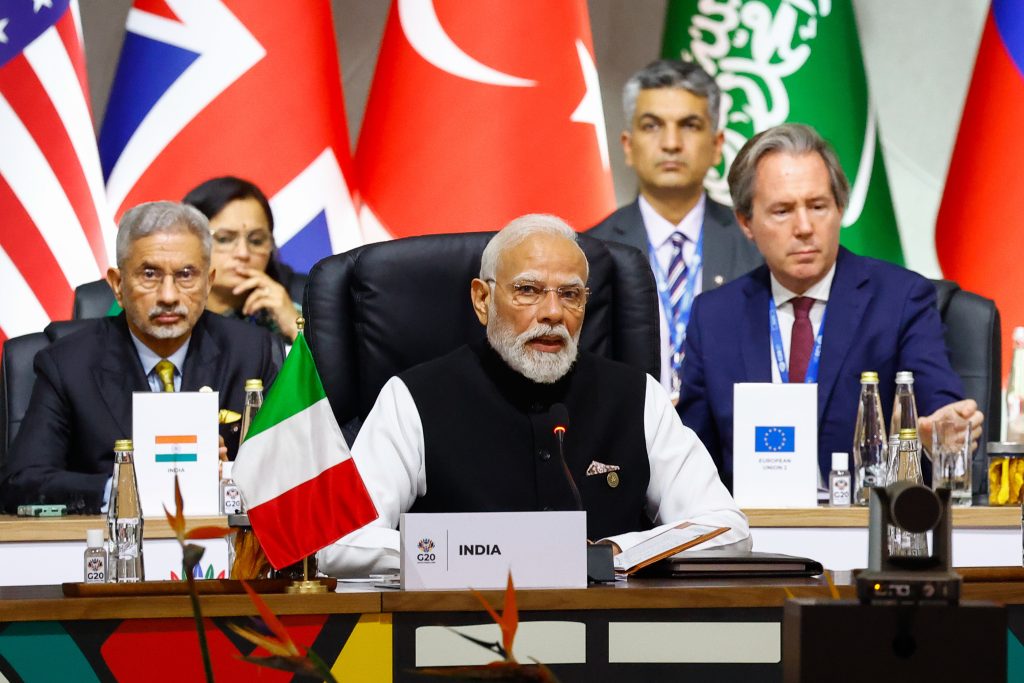
Modi at the plenary session in Johannesburg’s Nasrec Expo Centre. Photo: AP/PTI.
He called for a G20 Global Traditional Knowledge Repository, a G20 Africa Skills Multiplier program to train one million certified trainers over the next decade, and a G20 Global Healthcare Response Team for rapid deployment during health crises.
Modi also proposed a G20 Open Satellite Data Partnership to provide developing countries access to satellite data for agriculture and disaster management, a G20 Critical Minerals Circularity Initiative to foster recycling and strengthen supply chains, and a G20 Initiative on Countering the Drug Terror Nexus.
On the last proposal, he noted that fentanyl trafficking has become “a serious challenge to public health, social stability and global security” and “serves as a significant channel for financing terrorism”.
He also sought a greater voice for the Global South in global governance structures. “It is now essential that the spirit of this partnership extends beyond the G20. We must work together to ensure that the voice of the Global South is heard and strengthened across all global institutions,” he said.
In his speech Modi also invoked the concept of “Integral Humanism”. “This approach calls upon us to view the individual, society and nature as an integrated whole. Only then can we achieve true harmony between progress and nature,” he said.
Integral Humanism is the official ideology of the ruling party, formulated by Deendayal Upadhyaya, leader of the Bharatiya Jana Sangh, the BJP’s predecessor.
This article went live on November twenty-third, two thousand twenty five, at zero minutes past one at night.
The Wire is now on WhatsApp. Follow our channel for sharp analysis and opinions on the latest developments.

