
(Image credit: Getty Images)
Share this article
Join the conversation
Add us as a preferred source on Google
Newsletter
Subscribe to our newsletter
Investors searching for high growth often overlook the plumbing of the financial world. Yet the infrastructure that allows global markets to function is currently undergoing change. Beeks Financial Cloud is a Scottish technology firm at the heart of this change. By providing ultra-fast cloud computing and connectivity for the world’s most demanding traders and exchanges, Beeks is carving out a lucrative global niche. The company uses an unconventional pay structure that rewards staff heavily with shares, but the underlying investment case should be of interest to growth investors.
Beeks Financial Cloud’s promising partnerships
Most people use the cloud for things such as photos or emails. It is flexible and cheap, but slow. Beeks provides a private, super-fast service for those who need speed. It builds and manages the physical infrastructure that sits inside the same buildings as stock exchanges.
Sign up to Money Morning
Don’t miss the latest investment and personal finances news, market analysis, plus money-saving tips with our free twice-daily newsletter
Don’t miss the latest investment and personal finances news, market analysis, plus money-saving tips with our free twice-daily newsletter
Companies rent out the use of Beeks’ platform so they do not have to build their own expensive infrastructure. Instead, they plug in to Beeks to get the speed they need. Beeks handles all the complicated hardware, allowing the traders to focus on their strategies. Recently, Beeks has even started partnering with the exchanges themselves. When a new trader joins a major exchange, they are often using Beeks’ technology without even knowing it.
The future for Beeks looks bright because it has moved from being a simple technology seller to becoming a partner of large financial firms. In the past, Beeks sold one-off services to smaller trading firms. Today, it is winning multi-year contracts with banks and stock exchanges. This is important because it makes the income of the company much more predictable. Once an exchange integrates Beeks into its system, the cost and hassle of switching to a rival become almost impossible to justify.
A major driver of this growth is its Exchange Cloud product. Beeks has already signed up seven major exchange groups, including those in Australia and Canada. Beeks is now using a revenue-sharing model, which means as more traders join those exchanges and use Beeks’ infrastructure, it makes more money. It is a highly scalable way to grow – Beeks can increase its profits without having to find every customer itself. The exchange does the selling for it.
Beeks Financial Cloud is expanding global reach
The company is also expanding its global reach. A recent deal in Latin America will see Beeks support trading across Chile, Colombia and Peru. Meanwhile, major banks in South Africa and Canada signed five-year deals to use Beeks for their high-speed trading needs in London. Beeks typically starts with a small project for a client and then grows that relationship into a much larger partnership over several years.
Finally, Beeks is staying ahead of the competition through its own technology. Its new Market Edge Intelligence tool gives traders a level of detail on their trades that standard cloud providers struggle to match. By focusing on the most demanding portion of the global trading market, specifically the firms that need the absolute fastest speeds, Beeks has carved out a niche where it can charge premium prices and maintain high profit margins.
One aspect of Beeks that might raise an eyebrow for some investors is its unusual approach to pay. The company makes heavy use of equity, meaning it pays staff and executives partly in company shares rather than just cash. The chief executive, Gordon McArthur, famously takes a very low basic salary to keep costs down. While this might look odd on a balance sheet, it is important to understand what this means for you as a shareholder.
In simple terms, this structure aligns the staff interests with investors’ interests. When staff are paid in shares, they only really win if the share price goes up over the long term. This acts as an incentive for the team to stay focused on growth and efficiency. If the company does well, they do well. For a growing business, this can be smarter than paying large cash bonuses. By using shares, Beeks keeps more of its cash available to reinvest in expansion.
There is a trade-off. When a company issues new shares to pay its staff, it can lead to dilution. This means an investor’s slice of the company pie gets slightly smaller because there are more slices in existence. But in the world of technology, talent is everything. If Beeks can attract and keep the best engineers by giving them a stake in the business, the overall value of the company is likely to grow much faster.
This pay structure is unusual, but it is a sign of a founder-led culture. Doubters might focus on the size of share awards, but the reality is that this model creates a motivated workforce. For a company aiming to dominate a global niche, having a team that thinks like owners is a major advantage.
Beeks is successfully selling into a fast-growing market and carving out a global niche the tech giants can’t easily compete with. The company has proved it can win over the biggest names in finance and turn those wins into steady income. By staying focused on high performance and deep partnerships, it is building a solid platform for the years ahead. If Beeks continues on this path, it could become significantly more valuable over time.
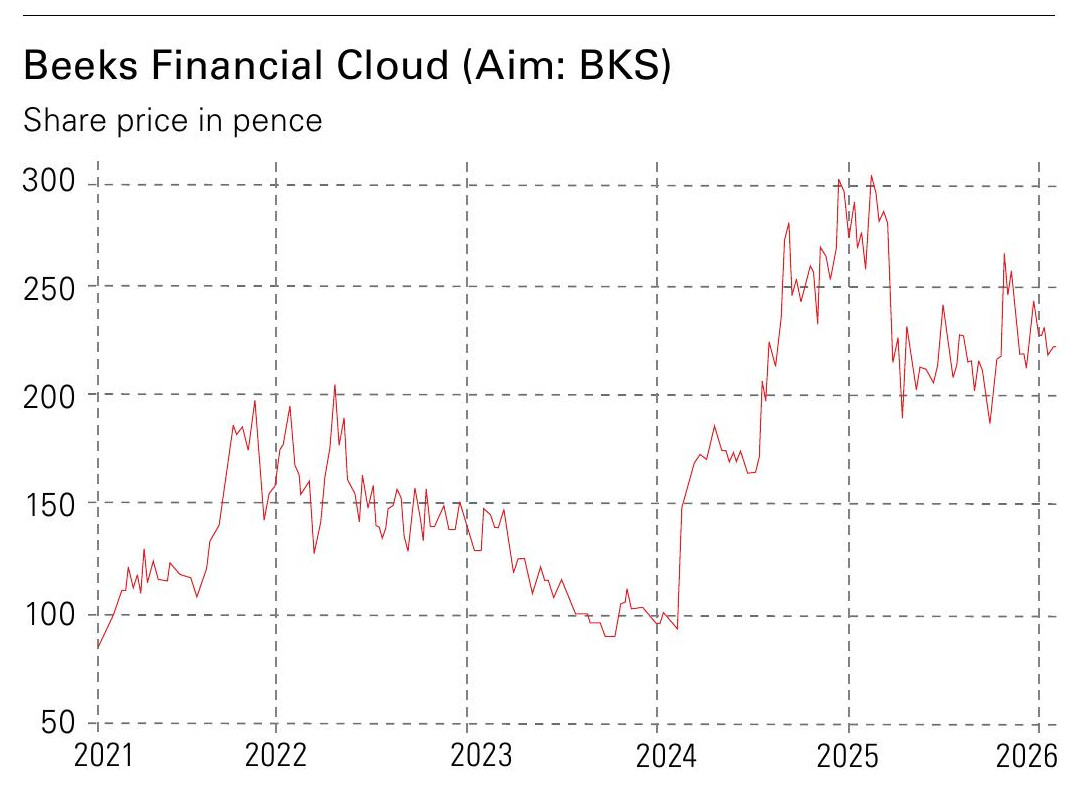
(Image credit: LSE)
This article was first published in MoneyWeek’s magazine. Enjoy exclusive early access to news, opinion and analysis from our team of financial experts with a MoneyWeek subscription.

