
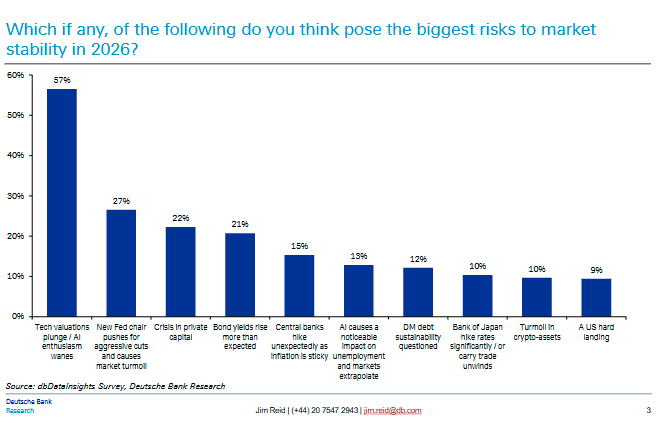
①In a recent report released this week, Deutsche Bank strategist Jim Reid outlined the main risks that respondents in a Deutsche Bank client survey believe the market will face in the coming year; ②Unsurprisingly, the bursting of the tech bubble tops the list: 57% of respondents ranked ‘a plunge in tech valuations / waning AI hype’ as one of the top three risks.
As the year-end approaches, Wall Street investment banks are currently providing their respective outlooks and assessments for next year’s market performance. In a latest report released this week, Deutsche Bank strategist Jim Reid outlined the main risks that respondents in a Deutsche Bank client survey believe the market will face in the coming year.
Unsurprisingly, the bursting of the tech bubble tops the list: 57% of respondents ranked ‘a plunge in tech valuations / waning AI hype’ as one of the top three risks. Reid pointed out that the bank had never seen a single risk so overwhelmingly dominant at the start of a new year in any of its previous surveys—this is clearly the most prominent concern for 2026!
 However, Reid also noted that some might argue that the prominence of bubble risks could instead trigger contrarian actions—since many investors are worried about it, the market frenzy may not have reached the anticipated extreme levels.
Regrettably, it is impossible to fully compare the current market sentiment with that of late 1999: after all, both mania and bubble concerns coexisted back then. The key difference, however, lies in the fact that the bubble in the late 1990s was global in nature, whereas the current potential bubble is highly concentrated in U.S.-based AI-related stocks.
That said, today’s leading AI companies far surpass any single stock from the year 2000 in terms of scale—and hold greater systemic importance. In fact, some even argue that the systemic importance of today’s AI firms has surpassed that of the banking system during the 2008 financial crisis. And as we all know, the outcome of that crisis was dire.
Further down the list, the second and third biggest risks for the coming year are, respectively, market turbulence caused by aggressive interest rate cuts implemented by the newly appointed Fed Chair (27%) and a private equity capital crisis (22%).
Reid also noted a significant rise in concerns about the Fed’s independence, given that convincing the entire board to support aggressive rate cuts would be no easy task.
Regarding private equity capital, this has become a frequently discussed topic among Deutsche Bank clients recently, especially following the collapses of First Brands, a U.S. auto parts supplier, and Tricolor, a U.S. subprime auto lender, which caused substantial losses for some private credit institutions. The core issue remains insufficient transparency in this sector, making it difficult to assess exposure and contagion risks.
Beyond the aforementioned top three risks, other notable risks for next year include:
Bond yields rise more than expected (21%), central banks unexpectedly raise interest rates due to sticky inflation (15%), AI significantly impacts unemployment rates and spills over into the market (13%), doubts about debt sustainability in developed markets (12%), the Bank of Japan sharply raises interest rates / unwinds carry trades (10%), cryptocurrency turbulence (10%), and a hard landing for the U.S. economy (9%).
Reed noted that among relatively lower-ranked risks, only 9% of respondents this time listed a hard landing for the U.S. economy as a top-three risk; thus, if the U.S. economy does fall into recession, it would be a major surprise.
For reference, last year, a global trade war was ranked as the top risk by 39% of respondents, with a tech bubble following closely at 36% — these were the hottest answers at the time. After the DeepSeek incident at the beginning of the year and ‘Liberation Day’ in early April, these consensus risks did briefly manifest but then quickly fizzled out.
So, this time, is the AI bubble, which 57% of respondents are most concerned about, correct, or has the market not yet reached a level of frenzy sufficient to burst? Perhaps everything still depends on time to provide an answer.
Editor/Doris

