
Goldman Sachs Forecasts an 11% Return for Global Markets Over the Next 12 Months

Goldman Sachs Forecasts an 11% Return for Global Markets Over the Next 12 Months – Funds Society

Outlook 2026

Canva

Stocks are expected to be supported by growth in corporate earnings and the global economy, although last year’s gains have pushed valuations to historically high levels

Diversifying across regions proved beneficial for investors last year and could continue to be, especially when combined with broader diversification across styles and sectors

The global bull market could continue in 2026, supported by growth in corporate earnings and resilient economic activity, although equity gains are unlikely to match the strong advance seen in 2025, according to Goldman Sachs Research. The firm expects continued global economic expansion across all regions and further moderate rate cuts by the U.S. Federal Reserve.

“Given this macroeconomic backdrop, it would be unusual to see a significant equity pullback or a bear market without a recession, even starting from elevated valuations,” writes Peter Oppenheimer, Chief Global Equity Strategist at Goldman Sachs Research, in the report Global Equity Strategy 2026 Outlook: Tech Tonic—A Broadening Bull Market.

Looking back, diversification was a central theme for Goldman Sachs Research last year. “Investors who diversified across regions in 2025 were rewarded for the first time in many years, and analysts expect diversification to continue in 2026, extending to investment factors such as growth and value, as well as across different sectors,” they explain.
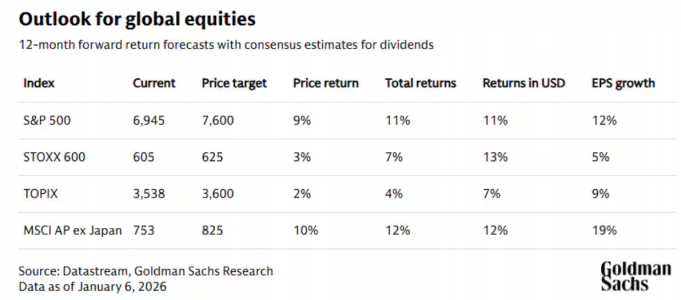
Outlook for Global Equities in 2026

“We believe that returns in 2026 will be driven more by earnings growth than by rising valuations,” says Oppenheimer. The 12-month global forecast suggests that stock prices, weighted by regional market capitalization, could rise by 9% and deliver a total return of 11% including dividends, in U.S. dollars. “Most of these returns are driven by earnings,” he adds. Commodity indexes could also advance this year, with gains in precious metals once again offsetting declines in energy, as was the case in 2025, according to Goldman Sachs.
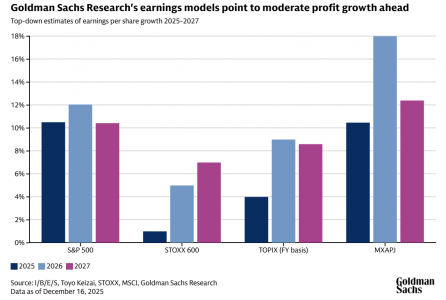
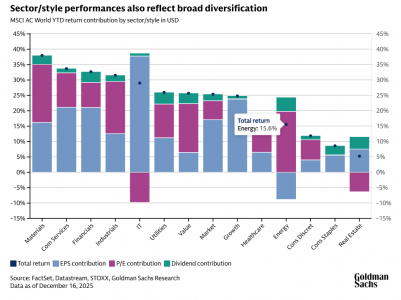
Diversification and Market Cycle

Oppenheimer’s team analyzes the typical phases of market cycles: despair during bear markets, a brief phase of hope after the initial rebound, a longer period of growth driven by rising earnings, and finally, a phase of optimism as investor confidence builds.

According to this analysis, equities are currently in the optimism phase of a cycle that began with the 2020 bear market during the pandemic. This stage is typically accompanied by rising valuations, suggesting some upside risks to baseline forecasts.

Should Investors Diversify in 2026?

Geographic diversification benefited investors in 2025, an unusual outcome, as the United States underperformed other major markets for the first time in nearly 15 years. Equity returns in Europe, China, and Asia were nearly double those of the S&P 500 in dollar terms, supported by the weakness of the U.S. currency.

While U.S. equities were driven primarily by earnings growth, especially among large tech companies, markets outside the U.S. showed a more balanced mix of improving corporate results and rising valuations. The growth-adjusted valuation gap between the U.S. and the rest of the world narrowed last year.

“We expect this convergence in growth-adjusted valuation ratios to continue in 2026, even though absolute valuations in the U.S. are likely to remain higher,” notes Oppenheimer’s team.

Diversification is expected to continue offering potential to enhance risk-adjusted returns in 2026. Investors may consider broad geographic exposure, including a greater focus on emerging markets, while combining growth and value stocks and diversifying across sectors.

Elevated Valuations and Sector Opportunities

Although equities performed strongly in 2025, outperforming both commodities and bonds, gains were not linear. The S&P 500 saw a nearly 20% correction between mid-February and April before rebounding. The sharp recovery that followed has left valuations at historically high levels across all regions, including Japan, Europe, and emerging markets.

Oppenheimer notes that non-technology sectors could perform well this year, and investors may benefit from companies that indirectly gain from capital investment by tech firms. Interest is also expected to grow in companies outside the tech sector as new capabilities related to artificial intelligence begin to materialize.

Is There a Bubble in Artificial Intelligence?

Market interest in artificial intelligence remains intense, though this does not necessarily signal a bubble. The dominance of the tech sector began after the financial crisis and has been supported by stronger-than-average earnings growth.

While the share prices of major tech companies have risen sharply, valuations are not as extreme as in past cycles, such as the peak of the tech bubble in 2000.

Related Posts


Latest articles

Related articles