
Against the backdrop of diverging monetary policies, rapid AI expansion, and market polarization, JPMorgan’s outlook for 2026 is neither simply optimistic nor entirely pessimistic, but rather points to a ‘new normal of resilience and risk coexisting.’
What is the overall outlook for global markets in 2026? Amid diverging monetary policies, accelerating AI expansion, and structural market differentiation, the global market in 2026 stands at a tipping point where resilience and risk coexist.
JPMorgan believes that front-loaded fiscal stimulus and robust corporate and household balance sheets will support continued global growth. However, weakening business confidence, a slowing labor market, and sticky inflation keep the risk of recession elevated.
 The bank expects that the stock market, driven by an AI supercycle, still has upside potential, while interest rates, exchange rates, credit, and commodities will show greater divergence. Investors will need to reassess timing, structure, and risk tolerance in a highly uncertain environment. The following sections will detail JPMorgan’s views.
2026 Global Market Outlook
In the coming year, global markets are likely to be defined by the convergence of multiple forces: diverging monetary policies, the continued expansion of artificial intelligence, and the intensifying polarization of markets. These factors, combined with the evolving U.S. policy agenda, will continue to reshape the global macroeconomic and market landscape.
Dubravko Lakos-Bujas, Head of Global Markets Strategy at JPMorgan, stated:
“At the core of our outlook is a multidimensional divergence: a split in equity markets between AI and non-AI sectors, a balancing act for the U.S. economy between strong capital spending and weak labor demand, and an increasingly widening divide in household consumption.”
Overall, JPMorgan Global Research believes that, supported by factors such as front-loaded fiscal policy, the global economic growth outlook for 2026 remains resilient. However, against the backdrop of weak business confidence and a persistently slowing labor market, downside risks remain at a relatively high level.
On the other hand, tailwinds from 2025 are expected to carry into 2026, including robust corporate and household balance sheets, ample liquidity, and the continued diffusion of AI-related capital expenditures, driving earnings growth.
Fabio Bassi, Head of Cross-Asset Strategy at JPMorgan, added:
“Overall, the market environment remains fragile, and investors must navigate a landscape where risk and resilience coexist.”

Stock Market
JPMorgan Global Research is optimistic about the global stock market for 2026, forecasting double-digit gains in both developed and emerging markets.
This bullish outlook is primarily based on steady earnings growth, declining interest rates, easing policy headwinds, and the continued rise of AI. Lakos-Bujas noted:
“An AI-driven supercycle is propelling record capital expenditures and rapid earnings expansion. This momentum is spreading to more regions and broader sectors, from technology, utilities to banking, healthcare, and logistics, continuously creating winners and losers in the process.”
In fact, AI may further amplify the divergence in an already uneven K-shaped economy, potentially driving market concentration to new highs.
He stated, “In such an environment, even if underlying trends remain intact and fundamentals stay solid, broad market sentiment indicators are more prone to significant volatility.”
-
U.S. stock market
The style allocation for 2026 is likely to continue the characteristics seen in 2025, with market crowding, concentration, and a ‘winner-takes-all’ pattern potentially reaching new extremes. Taking the S&P 500 Index as an example, JPMorgan Global Research anticipates that the AI supercycle will drive supernormal earnings growth of 13%-15% over the next two years at least.
-
Eurozone Stock Market
With the improvement of credit impulses and the gradual implementation of fiscal stimulus, the economic activity momentum in the Eurozone is expected to rebound in 2026. Profits are projected to grow by more than 13%, mainly benefiting from stronger operating leverage, a reduction in tariff headwinds, improved comparative bases, and a better financing environment.
-
Japanese stock market
The new Japanese Prime Minister Sanae Takaichi’s “Takaichi Economics,” along with the corporate reform process, is expected to boost the Japanese stock market in 2026. Companies may focus more on releasing excess cash, thereby driving capital investment, wage growth, and shareholder returns.
In addition, “Sao Miao Economics” is expected to revitalize middle-class consumption and strategic investment, providing further support for the market.
-
Emerging market stock markets
Against the backdrop of declining local interest rates, accelerating profit growth, attractive valuations, continuous improvement in corporate governance, healthier fiscal conditions, and resilient global growth, emerging market stock markets have a strong foundation for robust performance in 2026.
The Chinese private sector may show signs of recovery; South Korea continues to benefit from corporate governance reforms and AI development. In other regions, Latin America is expected to achieve significant upward movement driven by strong monetary policy stimulus and key political changes.
Global Economic Outlook
JPMorgan believes that the global economic expansion is at a critical juncture. Although GDP growth remains resilient in 2025, the demand is gradually shifting towards technology capital expenditures, and the stagnation of job growth has led to the emergence of structural imbalances.
Bruce Kasman, Chief Global Economist at JPMorgan Chase, stated:
“The cautious attitude of enterprises is the main drag on recruitment, reflecting concerns about trade conflicts and weak demand in non-tech sectors. The resulting insufficient labor demand is beginning to erode purchasing power, especially in the United States, where the slowdown in private sector labor income growth, combined with stabilizing inflation and short-term public sector drag, is putting pressure on consumption.”
Based on this, JPMorgan Global Research expects that consumption in developed markets will downgrade in the fourth quarter of 2025, and believes that the probability of a recession in the U.S. and global economy in 2026 is 35%.
However, thanks to the proactive fiscal stimulus, global GDP growth is expected to receive a boost in the first half of 2026, thereby improving market sentiment.
“Our baseline forecast suggests that the health of the corporate sector, loose financial conditions, and fiscal stimulus will help the global economy absorb the confidence shock currently suppressing labor demand. If the judgment is correct, as we move into the first half of 2026, employment growth and confidence will gradually rebound, supporting a renewed linkage between labor demand and robust GDP growth,” Kassman pointed out. In addition, a new wave of AI investment may also bring limited boosts to the global economy.
Inflation stickiness is expected to remain a dominant theme. After the supply shocks related to the pandemic and the Russia-Ukraine conflict gradually fade, the inflation level hovers around 3%, with almost no obvious signs of decline. Kassman added:
“The upward pressure on global commodity prices related to trade conflicts may be temporary, but we expect that higher commodity price pressures will persist at least in the first half of 2026.”
Interest Rate Market Forecast
J.P. Morgan’s global research hypothesizes that by 2026, the economic growth of most developed markets will reach or exceed potential levels, while inflation will continue to decline, although it remains sticky in some economies.
This may further exacerbate the divergence in monetary policy outcomes. For example, the Federal Reserve is expected to cut interest rates by another 50 basis points, while the Bank of Japan may raise rates by 50 basis points. Other central banks in developed markets are likely to remain on the sidelines or end their easing cycle in the first half of the year.
However, this baseline scenario still faces risks. In the United States, a more prolonged cyclical weakening of the labor market poses a downside risk, while the growth upside risk brought by AI applications serves as a hedge; both could affect the Federal Reserve’s policy response function in different ways. In the UK, the term premium surrounding fiscal events may rise again, and political uncertainty is also increasing.
Overall, JPMorgan believes that yields in developed markets are expected to gradually rise by 2026. By the fourth quarter, yields on 10-year U.S. Treasuries, German bunds, and UK gilts may increase to 4.35%, 2.75%, and 4.75%, respectively, with divergent performances across yield curves.
Jay Barry, Head of Global Rates Strategy at JPMorgan, stated:
“We expect U.S. Treasury yields to remain range-bound in the coming months, followed by a mild rebound after the Fed pauses its actions in the spring. Outside the U.S., we believe German and UK bonds will maintain their 2025 ranges and could weaken passively by mid-year as U.S. Treasury yields rise.”
In Asia, JPMorgan Global Research continues to hold a bearish view on Japanese government bonds (JGBs), anticipating a generally bearish flattening trend. Barry added, “We have yet to see any clear evidence indicating an imminent reversal of the bearish trend, particularly given that other developed markets may weaken by the middle of next year.”
Foreign Exchange Market Forecast
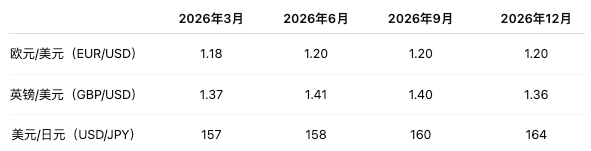
JPMorgan Global Research remains bearish on the U.S. dollar over the next year. Meera Chandan, Co-Head of Global FX Strategy at JPMorgan, stated:
“Our outlook for the U.S. dollar in 2026 is predominantly bearish, though both the magnitude and scope are smaller compared to 2025. The Fed’s ongoing concerns about labor market weakness, coupled with a risk environment favoring high-yield currencies amid the ‘middle segment of the smile curve,’ should broadly weigh on the dollar. However, robust U.S. growth and sticky inflation limit the extent of dollar weakness.”
On the other hand, JPMorgan Global Research holds a mildly bullish stance on the euro, primarily benefiting from the Eurozone’s growth prospects and Germany’s fiscal expansion. However, Chandan noted that unless U.S. data weakens significantly, the euro’s gains against the dollar may fall short of those seen in 2025.
For the British pound, opportunities for ‘buying on dips’ may arise amid resilient domestic growth, improving global growth expectations, and a favorable environment for carry trades. James Nelligan, FX Strategist at JPMorgan, stated:
“The structural headwinds facing the pound have not disappeared, so we prefer a tactical approach of buying on dips rather than adopting a longer-term bullish stance. We believe sterling strength is more likely to emerge in the first half of the year, while in the second half, fiscal concerns may come back into focus ahead of the next budget announcement, increasing the risk of underperformance for the pound.”
In Japan, the rapid rise of the US dollar against the yen has temporarily come to an end, but the yen still weakened slightly in 2025, underscoring the difficulty for the yen to consistently outperform while interest rates remain negative. Junya Tanase, Chief FX Strategist at JPMorgan Japan, stated:
“Entering 2026, as the easing cycle of G10 central banks nears its conclusion, it will become increasingly difficult to prevent yen depreciation through policy measures such as rate hikes or interventions. Furthermore, if the preliminary budget for fiscal year 2026 confirms the expansionary fiscal stance of the high municipal government, concerns about fiscal sustainability may further intensify downward pressure on the yen.”
Commodity Forecasts
JPMorgan noted that global oil demand is expanding, with expectations of a 900,000 barrels per day increase in 2026 and a 1.2 million barrels per day increase in 2027. However, the supply growth in 2026 is projected to be three times the demand growth, subsequently slowing to approximately one-third of that pace in 2027—potentially leading to significant surpluses on paper.
However, these imbalances are unlikely to fully materialize in reality, as adjustments may occur on both the supply and demand sides. Natasha Kaneva, Head of Global Commodities Strategy at JPMorgan, stated:
“We expect the market to rebalance through a combination of rising demand (driven by lower prices) and voluntary as well as involuntary production cuts. Based on this assessment, we maintain our forecast of $58 per barrel for Brent crude oil in 2026 and provide a first projection of $57 per barrel for 2027, while recognizing that stabilizing prices at this level will require considerable effort.”
For other energy products, increased liquefied natural gas (LNG) supply is expected to support lower global natural gas prices. Otar Dgebuadze, a member of JPMorgan’s Global Commodities Research team, stated:
“As new projects come online, we anticipate gradual declines in medium- to long-term prices from current levels. We forecast the average TTF (European natural gas benchmark) price to be €28.75 per megawatt-hour in 2026 and €24.75 per megawatt-hour in 2027, which is €3–4 per megawatt-hour lower than current forward prices.”
In precious metals, JPMorgan Global Research continues to be bullish on gold, primarily driven by increased central bank purchases and robust investment demand. Gold prices are projected to surge to $5,000 per ounce by the fourth quarter of 2026, with an average annual price of approximately $4,753 per ounce.
Gregory Shearer, Head of Base and Precious Metals Strategy at JPMorgan, added:
“Silver prices are expected to rise to USD 58 per ounce in the fourth quarter, with an average annual price of approximately USD 56 per ounce, while platinum may remain relatively strong through 2026 before supply rebalancing gradually takes effect.”
Finally, in the agricultural commodities market, implied volatility has risen recently. Tracey Allen, Agricultural Commodities Strategist at JPMorgan, stated:
“Although there are no imminent signs of shortages or supply-side pressures in the coming planting seasons, except in livestock and, to some extent, the cocoa market, our forecasts for the global agricultural commodities stocks-to-use ratio for 2026/27 and 2027/28 remain close to multi-year lows. The decline in available inventories driven by low producer profit margins has made prices more sensitive to supply-side disruptions, leading to increased volatility.”

 Looking to pick stocks or analyze them? Want to know the opportunities and risks in your portfolio? For all investment-related questions,just ask Futubull AI!

Editor/jayden

