
For Craig Moody, ball really is life.
In 2012, Moody, a former high school and college basketball coach, created Shoot 360, which uses motion-tracking and artificial intelligence to track players’ shooting, passing and ball-handling skills. Shoot 360 also uses gamification and leaderboards so players can compete with each other in person or virtually.
Today, the company operates 59 locations across the U.S. and a handful in Asia, with more expansion on the way through franchising. Shoot 360’s tech is also used by 29 of 30 NBA teams, and it’s inked deeper partnerships with the Warriors, Clippers, Jazz and Nets.
While the youth-sports market is the brand’s bread and butter, Moody also sees an opportunity to bring adults into the fold. Last year, Shoot 360 partnered with Ballislife to create a global shooting competition featuring teams of three, open to people ages 14 and above.
Moody sat down with Athletech News to discuss how he got the idea to blend hoops with modern technology, what’s next as the company expands, and why he believes Shoot 360 can be basketball’s version of pickleball.
The following conversation has been lightly edited for clarity and length.
Craig Moody: I’m a former high school and college basketball coach, and I’ve always had a lot of interest in developing players. As my kids started getting older, I realized the traditional grind, for basketball players, had kind of been replaced — there are just so many options that grab kids’ attention. One day, my oldest son had his teammates over at our house. We had a court and it was a beautiful day outside. I said, “Why don’t you guys go outside and play?” And they said, “No, we’d rather play video games.” I literally looked at my wife and said, “What if I could build a gym like a video game, where it could be immersive and fun?”
That resonated with me, so I had an idea to gamify (basketball) with content and training, and then put in an immersive experience where they’re building skills that are transferred to the court, but having a blast doing it. I rented a warehouse and started building it at night.
CM: No, but I have a couple of friends who did. One was in the software world and the other was an engineer. I convinced them to leave their high-paying jobs to take this on. We built out our plan, and we were literally making changes daily, building the architecture behind it as we went.
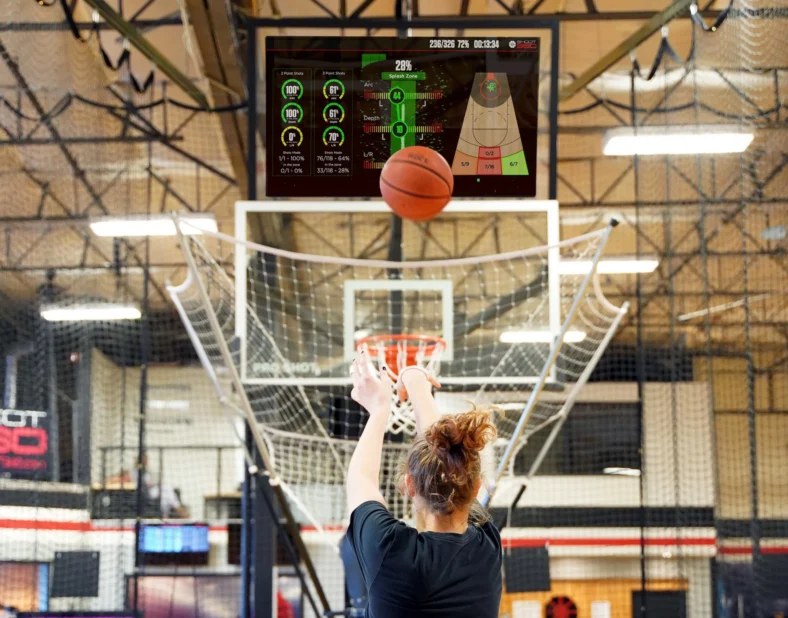
CM: We use machine vision to track the ball, and everything players are doing. We have three core disciplines: shooting, passing and ball-handling. We track every shot and every rep in real-time, and then measure things like arc, depth, alignment, passing velocity and ball-handling precision. Players get instant feedback while they’re working out, plus data and analytics stored in their personal profiles so they can access them on the app anytime they want.
You can also compete with other players. You could be in Brooklyn, I could be in Portland, Oregon, and we can play with each other. You can do that with up to eight players at once, so it creates a global competition. We do that with teams and single-player.
CM: 29 of the 30 NBA teams use our tech. It’s branded under Noah Basketball, but it’s our technology inside team facilities for developing players.
The NBA has been tremendous. The Golden State Warriors are franchisees, and we also do stuff with the Clippers, Jazz and Nets. The Warriors and Nets have a Shoot 360, while the Clippers and Jazz do co-branding, so we do camps and clinics. We’re also in the Clippers’ Intuit Dome as a fan experience. People can come in and play 45-second games to have a Shoot 360 experience. That’s been really popular.
CM: Basketball is such a global sport, and it’s super popular in culture through music and fashion. So we saw franchising as a great opportunity for people to get involved.
It’s now taken on a life of its own, where we’re growing internationally. There’s a tremendous amount of interest in Asia — we’ve sold locations in Japan, the Philippines, and Taiwan — and I think we’ll soon be in Indonesia, Thailand, Korea and India.
We also have locations open in Canada, and (former NBA Player) Zaza Pachulia is going to lead our Western Europe expansion; he already has a location in Eastern Europe at his academy. We also have opportunities in the Middle East, South America and Australia.
CM: Obviously, the big cities, the big basketball hubs. We’re very interested in New York, LA, Texas, Chicago and Florida. But we also see huge opportunities in smaller and mid-sized markets. We’re in Spokane, Washington, and Shreveport, Louisiana. Those communities love basketball just as much.
CM: I love talking about this. We always believed that the youth market would be our beachhead market because there’s an opportunity for them to potentially play varsity, then college, and a very small percentage beyond that.
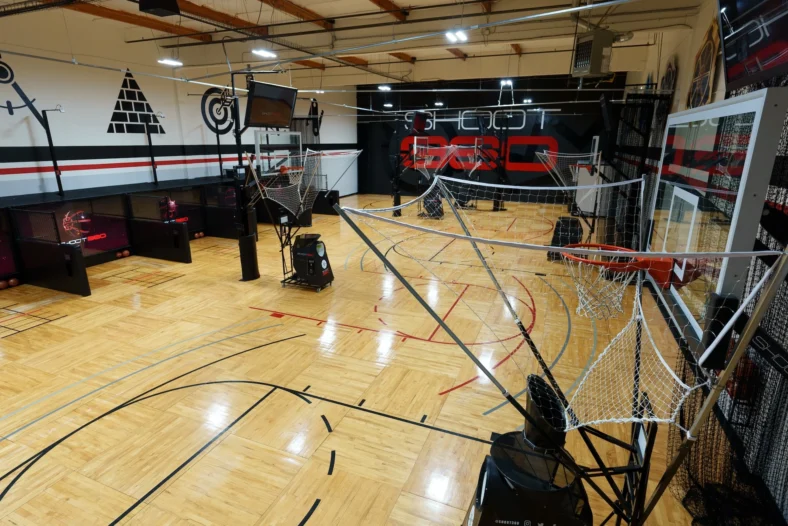
But we’ve always believed we could scale this into adults. The analogy is, we’re like what pickleball was to racket sports. People typically age out of basketball between 25 and 30 in the traditional game because of the rigors of it. They launched pickleball on a smaller court with a bigger ball, so anybody can play. We made a smaller court, and we took the best part of the game, which is shooting, and we made it low-impact. You’re also getting the social and competition aspect. So we think it’s a great way for adults to come off the sidelines and back into the game. They can play all the way up to 75.
CM: We’re continuing to refine our technology and user experience. We’re developing this digital ecosystem with data, AI-powered coaching, gamified training and global competitions.
And we plan on building facilities globally. The industry is well over $50 billion, so we think there’s a clear pathway to 1,500 to 2,000 locations worldwide, at least.
But I think the big thing for us is our mission is to grow the game. We’re not just building gyms; we’re building the world’s largest basketball participation community. We want all these people who have been sitting on the sidelines to come back in and play.

