
While the general aesthetics of earthmoving equipment has remained fairly constant for decades – excavator design has been honed and improved but a machine today is still recognisable compared with those from 50 years ago – the big changes have come inside the cab, both in terms of the technology options that are available but also regarding operator comfort and safety.
This all makes perfect sense; the technology is available to semi-automate and even automate tasks so that they are performed more efficiently and safely but it also makes sense given construction’s well publicised skills shortage. If there are fewer operators than ever before then ensuring they can work in an environment where they feel happy and comfortable becomes more important than ever.
Dominic Bunting, global marketing manager for backhoe loaders at Caterpillar, puts it clearly and succinctly when he says: “One of our customers’ biggest challenges going forward is a lack of skilled operators.”
A welcome feedback loop
Andreas Gstoettenbauer, head of product management at Wacker Neuson, says that operator and customer feedback is vital and comes through a variety of sources. “Close customer contact through our direct sales network, dealer partners, and continuous field feedback ensures we understand operator needs early. Across all channels – jobsite interactions, trade fairs, social media – priorities consistently point to safety, visibility, comfort, and intuitive usability. These factors directly shape our product development across the entire portfolio.”
He says that a good example of this in action is the company’s dual-view dumpers which were shaped by the feedback the OEM received. The dumpers help address visibility challenges by allowing operators to rotate their seat console, so they have a clear view in their chosen direction of travel.
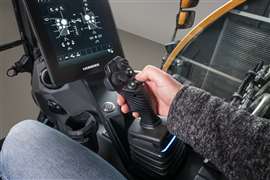 The inside of a cab offers operators more comfort and ease than in the past. (Image: Liebherr)
“By listening closely to operators and responding with targeted solutions, we create machines that are easier, safer, and more comfortable to operate – enabling safe yet high performance in increasingly demanding construction environments,” adds Gstoettenbauer.
Construction powerhouse Liebherr says that operator comfort is at the centre of every development. “The ergonomic workstations in our machines are designed in such a way that they enable stress-free working, even for long hours. Modern assistance systems support the operator so that he can work safely and efficiently,” says a Liebherr spokesperson.
When it comes to operator safety and comfort, the base level, of course, is the legal requirements regarding noise and vibrations but all OEMs are striving to increase safety and comfort as much as possible. Indeed, Liebherr says that, “The elimination of all disruptive factors at the driver’s workplace is the main objective in the development and component design of earthmoving machines.”
Bunting from Caterpillar echoes the previous comments and says that operator comfort is a “top priority” when developing machines. He reveals that this was a key reason for an update last year on the OEMs next generation machines.
“We introduced Electro-Hydraulic Seat Mounted controls on our latest generation of machines allowing operators to control front/rear or even at the same time from any seated position. This means operators can operate in a much more ergonomic position, prioritising their comfort alongside getting the job done,” says Bunting.
Last year Volvo Construction Equipment (Volvo CE) unveiled new generation upgrades to the 35-ton ECR355 short swing excavator, with a particular focus on the operator. The OEM says that it addresses key productivity challenges such as tight-space operation and demanding lifting needs as well as providing greater fuel efficiency and increased lifting performance. Volvo CE adds that the machine also provides an “industry-leading” operator environment with 20% more space compared to other short swing models.
“When designing any new product, we wanted to keep the interest of our operators at heart. The improved productivity within the ECR355 creates an unrivalled comfortable working environment across long shifts,” says Jaesu Kim, global product manager, Volvo CE.
He adds that, inside the cab, “operators will also find 50% better in-cab cooling performance, reduced noise levels due to new electric fans, and a host of modern conveniences, including Bluetooth connectivity, wireless phone charging, extensive storage solutions, and a two-stage filtration system for cleaner air.”
A global trend
This ever-increasing focus on operator comfort and safety is not something that is restricted to specific markets; it is a global trend. To illustrate this point, China-based XCMG comments that, “For decades, the focus in earthmoving equipment design was primarily on performance metrics – engine horsepower, dig depth, blade capacity, and lifting capabilities. While these remain crucial, a new era has emerged, placing operators at the forefront,” says a spokesperson for the company.
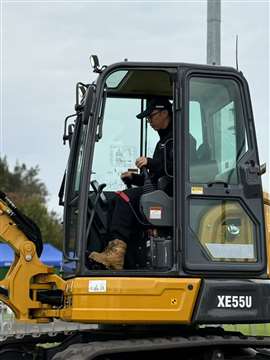 XCMG says that the next frontier in earthmoving equipment is machines that adapt to the operator in real time. (Image: XCMG)
“Comfort, safety, and technological integration are now considered equally essential to ensure efficiency, productivity, and long-term operator well-being. At XCMG, this evolution is not just a trend; it’s a core philosophy. Operators are at the centre of every design decision. Machines are engineered around their needs – from ergonomics to smart technology – enabling them to work longer, safer, and with reduced fatigue.”
The resounding message coming from the manufacturers of earthmoving equipment is that operator safety and comfort are key. This will remain the case in the future but how might these areas evolve and, with technology ever-changing, how might the role of the operator themselves alter in years to come?
“Over the next five to ten years, we expect the operator’s role to evolve significantly – but not disappear. Construction sites will remain too dynamic, too variable, and too complex for full automation in the near term. Instead, assistance systems will increasingly take over repetitive or safety-critical tasks while operators remain in command,” comments Gstoettenbauer from Wacker Neuson.
“We are actively researching these next steps. Together with university partners, we are testing concepts, for example for automated bulk material transport, including autonomous routing and ‘Find-Me’/’Follow-Me’ functions tested under real jobsite conditions. The challenge remains the constantly changing construction environment, which requires highly adaptive perception and control systems.”
This article started by stating how the design of most earthmoving equipment has remained unchanged for decades – it may well be that in the next decade the operator’s role undergoes one of its biggest changes for decades.
Bobcat’s B730 M-Series backhoe loader
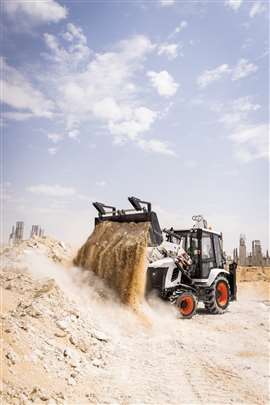 The B730 M-Series backhoe loader is designed for markets in the Middle East and Africa and CIS regions. (Image: Bobcat)
The B730 M-Series Backhoe Loader from Bobcat is designed for markets in the Middle East and Africa (MEA) and CIS regions. The B730 M-Series is said to offer high performance, ease of operation and superior comfort.
Conceived and built at the Doosan Bobcat manufacturing facility in Chennai, India, the B730 M-Series is the latest addition to the Bobcat backhoe loader range, providing a model for the value market.
Available in a choice of different configurations and matched with attachments for diverse applications, the B730 M-Series is ideal for use in construction, rental, roadworks, demolition, excavation, landscaping and many other industries.
“Together with our customers and experienced dealer network we developed a machine that is ideal for mixed contractor and rental fleets,” said John Chattaway, loaders product manager at Bobcat.
XCMG certainly thinks so, with a spokesperson for the company saying that, “The next frontier in earthmoving equipment is machines that adapt to the operator in real time. Sensors, smart hydraulics, and advanced software now allow machinery to respond intuitively – adjusting speed, pressure, and control sensitivity based on the operator’s movements and workload.
“This approach transforms the operator’s role from constant manual adjustment to strategic decision-making. For example, an excavator can subtly modulate boom speed during delicate digging, or a bulldozer can maintain perfect grading lines automatically, letting the operator focus on precision rather than effort,” says a spokesperson from the OEM.
This blending of human skill with intelligent machine response offers the construction industry a tantalising glimpse of the future; one with less operator fatigue and mistakes, and smoother workflows.
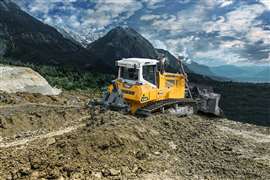 Liebherr says that operator comfort is at the centre of every development. (Image: Liebherr)
Of course, intelligent control and assistance systems in earthmoving equipment already ensure that these machines react independently to potential obstacles and sources of danger, as well as helping to guarantee tasks, such as digging to a certain depth.
The team at Liebherr says that now – and in the future – there is, “no such thing as the optimum degree of automation.” The OEM is making the point that the demands placed in earthmoving equipment are so varied and diverse from task to task, site to site, and country to country that there is no ‘one size fits all’ approach.
It is good news for those who want technology to make human lives better rather than take over the creative and interesting tasks, as that is exactly how Liebherr sees the future for operators. “Where human creativity, inventiveness and the ability to solve problems are required, the operator will continue to play a decisive role,” says a spokesperson for the company.
“Where work is characterised by great monotony, a high or even complete degree of automation will probably become apparent sooner than in the next five years. However, the rapid change of operating mode is also an important factor.
“For example, in a very monotonous job, a machine can work autonomously for a few hours but can easily be operated manually or remotely when required for more challenging tasks (for example, digging out a bulky boulder). Once the special task has been completed, the machine is switched back to autonomous operating mode. In this way, the strengths of the human operator and the autonomous system can be ideally combined.”
An optimistic view of the future
The future for earthmoving equipment operators may well be more comfortable and more ergonomically designed seats, the latest air conditioning and heating, increased visibility and – crucially – automated assistance when it comes to repetitive tasks.
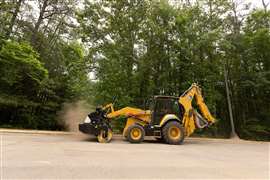 Cat says that that its next generation backhoe loaders feature improved machine performance, an advanced hydraulic system and increased versatility. (Image: Caterpillar)
“Human-machine interaction is developing rapidly, and operators will expect clearer, more intuitive, and more integrated digital workflows [in the future],” says Gstoettenbauer. “As a result, operators will increasingly supervise and optimise smart, sensor-rich, partially automated machines. Their task profile will shift toward managing and optimising these systems, leading to higher safety, efficiency, and overall jobsite performance.”
This sentiment is echoed by Liebherr. The company says that, in the medium-term future, the path will continue from a single autonomous machine to systems consisting of several different types of machines involved in a material flow process.
A spokesperson for the OEM adds that, “In some cases, this may be completely autonomous but manually operated and autonomously operating machines may also be involved along the process. The role of the operator is thus evolving in the direction of a coordinator of the entire material flow.”
Rather than diminishing the role of the operator, the industry’s technology roadmap points firmly toward greater operator effectiveness. With automation handling repetitive and high-risk tasks, operators are set to become supervisors, decision-makers and coordinators of increasingly intelligent machines. If manufacturers get that balance right, the result will be safer sites, more efficient workflows and a more attractive profession at a time when skilled operators are in short supply.
Comfort-led SDLG E6215H at work in Thailand
On a jobsite site in Thailand a E6215H excavator from China-based SDLG that has been designed for operator comfort is being used.
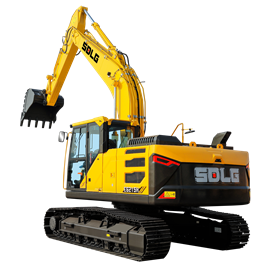 SDLG’s E6215H has a fully electronically controlled hydraulic control system. (Image: SDLG)
The cab of the E6215H is a 0.9-meter space, nearly 10% larger than the standard size for this equipment type with a wide field of vision and a large skylight.
The seat is shock-absorbing and, according to SDLG, can filter out over 90% of the body vibration. The cab has fully enclosed sound insulation design and also features a three-dimensional air conditioner air outlet and strong wind force. Commonly used buttons such as start and stop, and lights are centrally arranged, allowing even beginners to hit the target with just one press.
Previously, when lubricating the excavator, the operator had to climb up and down the machine. Now, with the centralised lubrication and maintenance design of the E6215H, it can be done in just 20 minutes. The optional fuel filling pump is even more ‘hands-free’. Connect the fuel pipe and press the switch, and the fuel will be automatically filled.
The E6215H has a fully electronically controlled hydraulic control system independently designed and developed by SDLG which is said to feature a fast response speed and intelligent auxiliary operation.

