
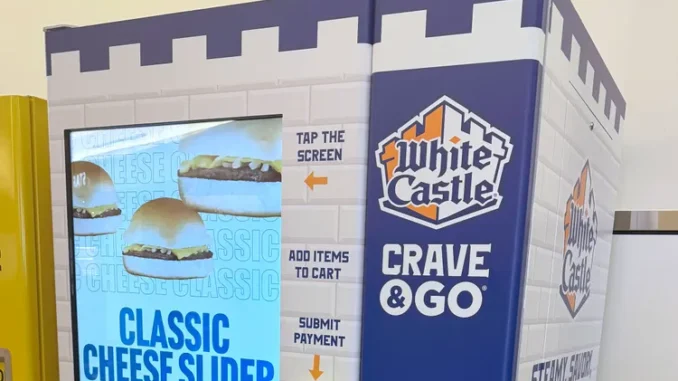
White Castle’s latest technology push is less about novelty and more about redefining where and how a restaurant can exist. The company’s plan to deploy 1,000 automated “Crave & Go” kiosks across the U.S. serves to expand the restaurant footprint beyond traditional real estate, into a distributed, tech-enabled network of micro-locations.
The initiative centers on fully automated kiosks capable of preparing hot food on demand, with an initial focus on institutional environments such as hospitals, college campuses, and corporate workplaces. These are locations where demand for convenient, ready-to-eat meals is consistent, but where a full-service restaurant is often impractical or economically unviable.
By targeting these environments, White Castle is effectively extending its brand into spaces that have historically been underserved by traditional quick-service models. The company is not just adding points of distribution. It is rethinking the underlying unit economics of restaurant expansion.
Unlike brick-and-mortar locations, which require significant capital investment, staffing, and ongoing operational overhead, automated kiosks offer a fundamentally different cost structure. Labor requirements are minimal, physical footprints are smaller, and deployment timelines are shorter. This allows for a level of scalability that conventional formats struggle to match.
At the same time, the technology underpinning these kiosks is becoming increasingly viable. Advances in automated food preparation, temperature control, and remote monitoring have made it possible to deliver a consistent product without on-site staff. The partnership with Automated Retail Technologies reflects a growing ecosystem of providers focused specifically on enabling this type of unattended retail.
What makes the “Crave & Go” rollout particularly notable is its emphasis on on-demand preparation rather than pre-packaged food. This distinction matters. Vending machines have existed in the restaurant industry for decades, but they have typically been associated with limited variety and lower perceived quality. By preparing food in real time, White Castle is attempting to bridge the gap between convenience and freshness, a challenge that has long constrained automated retail.
Early indications suggest that consumer response has been positive, with initial deployments generating strong engagement. That aligns with broader shifts in consumer behavior, particularly among younger demographics, who place a premium on speed, accessibility, and frictionless transactions. In many cases, the ability to access food quickly and without interaction is not just a convenience, but an expectation.
White Castle is not alone in exploring this model. Other operators are experimenting with adjacent forms of automated retail, from self-ordering kiosks deployed at scale by major quick-service chains to fully unattended food concepts in urban markets. Brands like McDonald’s and Bojangles have expanded self-service kiosk deployments to improve throughput and average check size, while newer entrants are testing vending-style formats that dispense fresh or prepared meals in nontraditional locations. In San Francisco, for example, a concept called Pasta Supply Co. has introduced refrigerated vending machines offering chef-prepared meals as a lower-cost alternative to delivery, underscoring how both large chains and independent operators are converging around automation as a way to extend reach and reduce reliance on labor.
For restaurant operators, the implications extend beyond White Castle itself. The model introduces a new category of competition, one that does not rely on traditional storefronts or even traditional labor models. As automated kiosks become more sophisticated, they have the potential to capture demand in high-traffic environments before it ever reaches nearby restaurants.
This is particularly relevant in settings like hospitals and campuses, where foot traffic is concentrated and time constraints are significant. In these environments, proximity and speed often outweigh brand loyalty. An automated kiosk that delivers a hot meal in minutes can effectively compete with both on-site dining options and off-site delivery.
The rollout also highlights the growing importance of menu adaptation. White Castle has indicated that it plans to test new products specifically designed for automated environments. This suggests that not all menu items will translate effectively to this format, and that success will depend in part on optimizing offerings for consistency, preparation time, and equipment constraints.
This mirrors a broader trend in restaurant technology, where menus are increasingly being shaped by the capabilities of the systems used to produce them. As automation becomes more prevalent, the relationship between menu design and operational technology is likely to become even more tightly coupled.
There are, however, limitations. Automated kiosks are well suited to a narrow range of use cases, particularly those involving standardized, high-volume items. They are less adaptable to complex menus or highly customized orders. For many restaurants, especially those that differentiate through service or culinary experience, this model will remain complementary rather than competitive.
Even so, the scale of White Castle’s planned deployment underscores the seriousness of the effort. A network of 1,000 kiosks represents not just a pilot program, but a strategic expansion channel. If successful, it could pave the way for broader adoption across the industry, particularly among quick-service and fast-casual brands looking to extend their reach without the constraints of traditional locations.
In that sense, the “Crave & Go” initiative is part of a larger shift toward distributed restaurant models. Instead of relying solely on centralized kitchens and storefronts, brands are beginning to explore more flexible, technology-driven approaches to production and distribution. These models are still evolving, but they are increasingly aligned with the realities of modern consumer behavior.
For now, White Castle’s approach offers a clear indication of where the industry may be heading. The restaurant is no longer confined to a single place. It is becoming a network, enabled by technology, designed to meet demand wherever it arises.

