
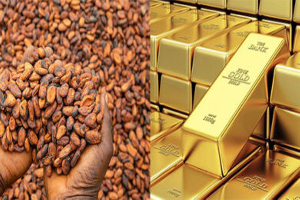
 Cocoa and gold are key export commodities for Ghana
Peter Bismark Kwofie, the Executive Director of the Institute of Liberty and Policy Innovation (ILAPI), has warned that global conflicts could reduce demand for Ghana’s key export commodities, including cocoa, gold and timber.
Such a development, he said, could reduce foreign exchange inflows and exert pressure on the cedi.
To prevent this, he called for increased investment in local manufacturing and industrial production.
“We must strengthen our factories and industries so that we produce more locally instead of relying heavily on imports,” he advised.
Kwofie, reacting to the current crisis in the Gulf Region, in an interview with the Ghana News Agency (GNA) recommended strict fiscal discipline during the current period of global uncertainty, noting that international investors often become cautious during geopolitical conflicts.
As a precautionary measure, he suggested that Ghana consider extending its programme with the International Monetary Fund (IMF) for an additional year to serve as an economic buffer.
“If the IMF programme ends immediately, we will have to manage the economy entirely on our own at a time when global tensions remain unpredictable,” he explained.
On security concerns, Kwofie dismissed suggestions that Ghana could become a potential target because of the presence of United States facilities in the country.
He clarified that such facilities in Ghana are not used for intelligence interception or military operations related to conflicts in the Gulf region.
“It does not mean that every country hosting a U.S. facility automatically becomes a target,” he said.
He therefore urged Ghana to maintain a neutral diplomatic stance in the tensions between the United States and Iran and continue advocating for peace through international platforms such as the United Nations.
Kwofie urged Ghana and other African countries to remain calm but vigilant while focusing on strengthening their economies.
“We should not panic as Africans,” he said. “But we must remain neutral, call for de-escalation and focus on building strong and resilient economies.”
He said that with strategic policies such as industrialisation, export diversification, disciplined fiscal management and the development of strategic reserves, Ghana would be better positioned to withstand global economic shocks.

