
The newly expanded partnership between Block and Uber Technologies reflects a deeper shift underway in restaurant technology, one that is steadily moving the industry away from fragmented systems and toward tightly integrated, ecosystem-driven platforms.
Announced this week, the agreement extends Square’s native integration with Uber Eats into multiple international markets while introducing Cash App Pay as a payment option across Uber’s U.S. platform. On the surface, the update builds on an existing relationship. In practice, it signals a more aggressive push to unify ordering, payments, and operations into a single, interconnected environment.
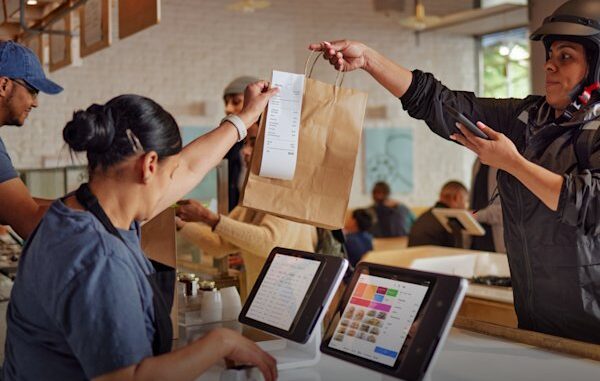
For restaurant operators, the operational implications are immediate. Square’s integration allows orders from Uber Eats to flow directly into the POS, eliminating the need for additional tablets and reducing the manual steps that have long defined third-party delivery workflows. Tablet sprawl remains a persistent friction point across the industry, contributing to order errors, slower kitchen throughput, and increased training complexity. Consolidating those channels into a single interface is less about convenience and more about restoring operational control.
The integration also enables centralized management of menus, modifiers and inventory across channels. This has become increasingly important as restaurants balance on-premise dining with delivery and takeout. Disconnected systems often lead to inconsistencies, particularly during peak periods, when menus may not reflect real-time availability. Bringing those controls into one system reduces that risk while improving the ability to dynamically adjust offerings based on demand.
Equally important is the financial layer being embedded into the workflow. Instant Payouts, highlighted as part of the integration, point to a broader trend in which cash flow management is no longer confined to back-office processes. Instead, it is becoming an operational lever, giving operators faster access to revenue generated through third-party channels. In an environment where margins remain under pressure, that timing can have a measurable impact.
The introduction of Cash App Pay adds another dimension, shifting the focus from operational efficiency to consumer behavior. With 59 million monthly transacting users, Cash App represents a large and growing base of predominantly younger consumers. Integrating that payment option directly into Uber and Uber Eats does more than expand checkout flexibility. It creates a pathway for restaurants to tap into a demographic that is more likely to engage with digital wallets, promotions, and alternative payment experiences.

This reflects a broader industry trend in which payments are evolving from a passive utility into an active driver of engagement. Payment methods are increasingly tied to offers, loyalty, and financing options, shaping how and where consumers choose to spend. For operators, the implication is that payment strategy is becoming inseparable from marketing and customer acquisition.
The global expansion component of the partnership further underscores its strategic significance. Square’s Uber Eats integration, already established in the U.S., is set to extend into markets including Canada, the U.K., Australia, Ireland, France, and Spain. This move points to the gradual standardization of restaurant technology across regions, replacing localized, often fragmented solutions with globally consistent platforms.
For multi-unit and international operators, this has clear advantages. Standardization can simplify training, reduce integration costs, and provide more consistent data visibility across locations. At the same time, it raises questions about platform dependency, particularly as a small number of providers expand their influence across both merchant operations and consumer interfaces.
The competitive context is equally important. Block continues to position itself as more than a POS provider, building an ecosystem that spans payments, financial services, and consumer-facing products. Uber, meanwhile, is extending its role beyond delivery into a broader transactional platform that connects mobility, commerce, and logistics. Together, they are creating a vertically integrated model that challenges both traditional POS vendors and standalone delivery aggregators.
For restaurant operators, the decision landscape is shifting. The question is no longer simply which tools to deploy, but which ecosystems to align with. Integrated platforms promise efficiency and scale, but they also concentrate control, particularly around data and customer relationships.
The Block-Uber partnership illustrates how quickly that shift is accelerating. What was once a series of integrations is becoming something closer to infrastructure, embedding ordering, payments, and financial services into a unified system. For operators navigating labor constraints, margin pressure, and rising consumer expectations, that level of integration is increasingly difficult to ignore.
At the same time, it introduces a new set of strategic considerations. As technology providers expand across both sides of the transaction, from restaurant operations to consumer payments, the balance of power within the ecosystem continues to evolve. The operators who benefit most will likely be those who understand not just how to adopt these platforms, but how to use them without becoming overly dependent on them. That tension, between efficiency and control, is likely to define the next phase of restaurant technology innovation.

