Annalena Baerbock defends UN’s relevance despite rising global conflicts and criticism. Pushes for reforms, stronger multilateralism, and greater representation, with India seen as key partner

Amid Global Conflicts, UN Admits Challenges but Defends Its Role: UNGA President Annalena Baerbock
Amid Global Conflicts, UN Admits Challenges but Defends Its Role: UNGA President Annalena Baerbock
-
Annalena Baerbock admits UN faces challenges but says it remains indispensable.
-
Push for reforms, including Security Council changes and “UN80” agenda.
-
Highlights India’s role; calls for first woman UN Secretary-General.
As the United Nations grapples with a growing credibility crisis in conflict resolution from West Asia to Russia -Ukraine, the President of the UN General Assembly Annalena Baerbock acknowledged concerns over the organisation’s effectiveness, even as she defended its indispensability.
Responding to a question from the Outlook Business, on the growing criticism of the UN with regards to its ineffectiveness in conflict resolution over the ongoing wars, the President of the UNGA said, “Yes, you are absolutely right that at the present, we are facing challenges with regards to finding peace and ceasefire in conflicts and crisis situations. But at the same moment, we should remember that without the UN, there would be no peacekeepers, the World Food Program would leave crisis in places like Sudan, and the World Health Organization’s vaccination programs would cease.
She further added that, “Even aviation safety is regulated by a UN body. And we are improving and reforming in many sectors such as at digitalization to eliminate hard copies of materials. However, we will maintain human skills for the six official UN languages rather than relying solely on AI. Yes, we are facing serious challenges but we are also looking at reforms. I call on member states to offer supportive reform proposals rather than weaponizing the process to weaken the institution.”

1 April 2026
Get the latest issue of Outlook Business

Her remarks came during a press conference in New Delhi on Tuesday, as she began her India visit at a time of intensifying geopolitical turbulence.


‘
);
}
With the war in Iran continuing to destabilise West Asia, the Russia-Ukraine conflict dragging on, and global institutions under strain, the visit also coincides with India’s renewed push for long-pending reforms of the UN Security Council.
Opening her remarks, the UNGA President struck a cautionary note on global interconnectedness, pointing to how disruptions in critical regions—from the Strait of Hormuz to conflict zones—have worldwide consequences.
“The UN Charter is our common life insurance,” she said, underlining that adherence to international law and the Sustainable Development Goals (SDGs) is in the shared interest of all nations.
‘
);
}
She described India as a central pillar of the multilateral system, highlighting its historical and ongoing contributions—from sending over 300,000 peacekeepers to UN missions to championing South-South cooperation through development partnerships.
She also invoked the legacy of Indian reformers such as Dr Hansa Mehta, who played a key role in shaping the language of the Universal Declaration of Human Rights.
On the question of reform, particularly of the Security Council, she acknowledged the frustration over the slow pace of progress.
“The debate has been ongoing for 17 years,” she noted, adding that proposals from countries like India and blocs such as the African Union remain under discussion.
While no breakthrough appears imminent, she pointed to incremental steps such as the ‘Veto Initiative’, which allows the General Assembly to deliberate on issues blocked in the Council.
Addressing concerns over the UN’s operational inefficiencies, she outlined the ongoing “UN80” reform agenda, which aims to streamline mandates, reduce duplication, and enhance field-level impact.
Measures under consideration include merging agencies and increasing digitalisation, although she cautioned against over-reliance on artificial intelligence at the cost of human expertise.
On global conflicts, she reiterated strong condemnation of attacks on peacekeepers and flagged the worsening humanitarian situation in Gaza and Lebanon.
The safety of UN personnel, she stressed, remains a collective responsibility of all member states.
She also used the platform to make a case for greater gender representation at the top of the organisation, noting that in 80 years, the UN has never had a woman Secretary-General.
With the selection process underway, she said choosing a woman would be a crucial “statement of intent” about the institution’s commitment to equality and credibility.
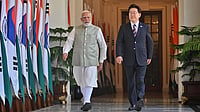
Notably, President Baerbock is visiting India on 28 April at the invitation of the Government of India as part of a broader visit to Asia.
During her stay, she met with senior government officials, including External Affairs Minister Dr S. Jaishankar, representatives of India’s Ministry of Electronics and Information Technology, and the UN Country Team in India, as well as representatives of the UN Country Team in Bhutan.
She will travel onward to China from April 29-30 for further high-level engagements.
- Previous Story
CropLife India Pushes For 5-Yr Data Protection In Pesticide Bill, Regulation Of E-Comm Platforms
- Next Story
FTA To Help India’s Engineering Exports To New Zealand Double to $280–300 Mn in Five Years